How to Make the Most of Your MBA
A practical guide to managing your time, learning beyond the curriculum, building a sustainable lifestyle, and keeping perspective across two intense years.
Time Management Is the Central Skill of the MBA
Your number one challenge during the MBA will be making choices. The program throws more events, clubs, trips, social opportunities, and career commitments at you than anyone can fit into two years. Most admits arrive full of ambition and end up overwhelmed by the end of first term.
FOMO (Fear Of Missing Out) is the main obstacle. Every event seems worth attending. Every trip sounds unmissable. The desire to make the most of everything drives decisions that leave you burned out. Most students finish with some regrets around having spent too much time on certain things, not enough on others.
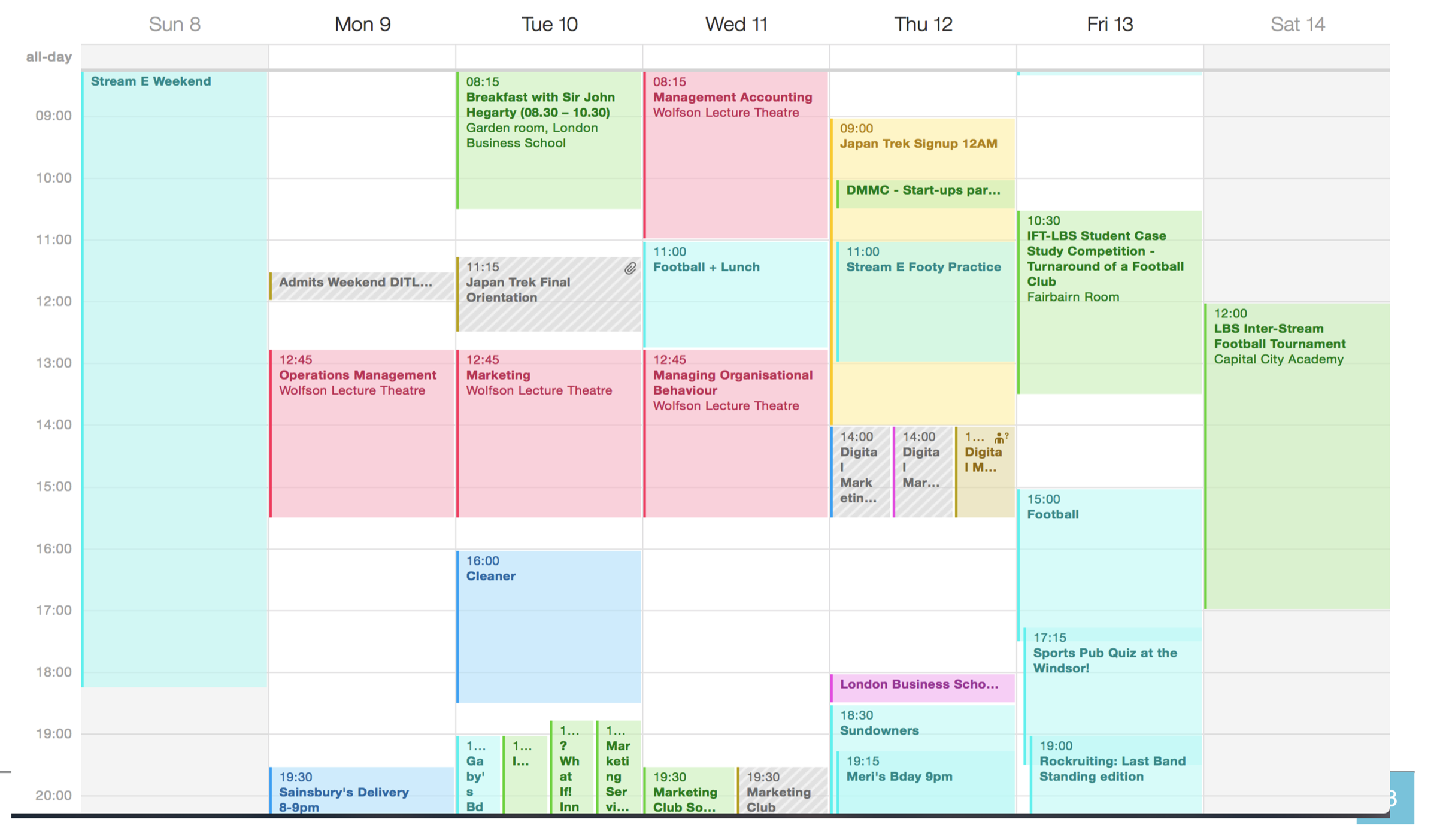
A real calendar extract from an MBA program. Without a plan, FOMO decides for you.
A good starting point is to list all the activities competing for your time and decide upfront what share of each week you want to allocate to each category. The exercise forces you to make trade-offs deliberately, before FOMO starts making them for you.
 GMAT Panda GMAT Panda | ||
|---|---|---|
| Category | What it covers | Things to consider |
| Class & study | Lectures, self-study, group work, case prep | Your grades probably wont matter as much as you think. For some competitive recruiting roles, they might matter a bit, but for most, they won't. The real question is what classes do you want to learn the most from? Identify those and make sure you do the pre-readings, as you will benefit a lot more from the class itself. |
| Career activities | Research, networking, career events, interview prep | If you're aiming for a role in finance, you'll need to spend a lot of time on research and networking, as well as attending career events and interview prep. This is less the case in consulting. For corporate and tech roles, it very much depends on the field. Ask alumni and find out what they did. |
| Club & campus life | Club events, committee roles, school trips | Beware of clubs you want to join just out of curiosity. If you're not planning on taking an active role, that time may be better spent elsewhere. |
| MBA social life | Dinners, parties, informal socializing with classmates | Introverts often need more recovery time than they budget for. Another good question is how much is building a network important to you? The truth is that the strongest bonds are often built in social activities. So if you want your peers to remember you after the MBA, you'll need to have some social presence. |
| Personal relationships | Family, partner, friends outside the MBA | It's not a myth that MBAs lead to divorces, but it's also true that people change a lot during MBAs. A divide may appear between you and your partner or friends. It's important to keep in touch with people who matter to you, and take them through your journey so they can relate. |
| Health & maintenance | Sleep, exercise, eating, commuting, life admin | If you're too tired or stressed, you will be much less effective at getting things done and making decisions, which will compound the problem. |
| Down time & admin | Reading, hobbies, watching something, emails, miscellaneous tasks | Most people underestimate this significantly. It's also important to have some down time to do a weekly check-in on your priorities, and make sure you're on track to achieve your goals. |
Once you have a rough share for each category, work out approximately how many hours per week each one gets. Keep in mind that a significant portion of your attention will be taken by small things not on this list. Build in slack, and revisit the split at the end of each term.
Plan the day before
Decide the next day's priorities the evening before. This removes the spontaneous element from decision-making and gives you extra strength to say no when FOMO arrives.
Protect your mornings
Many MBA students find that getting up 30 to 60 minutes earlier creates an uninterrupted window for planning and reflection. At 7 AM, nobody is asking you for anything yet.
Learn from Your Classmates, Beyond the Classroom
The MBA curriculum teaches business fundamentals. What it often doesn't cover is the operational and technical expertise your classmates bring from their pre-MBA careers.
Among your cohort there will be experts in supply chain management, digital marketing, financial modeling, data analysis, product management, and more. Some of those skills will be genuinely valuable to you at some stage of your career. Identify which ones matter for where you want to go, and find the people who can teach you.
The most effective way to learn a practical skill without taking too much of a classmate's time is to work on a personal side-project and ask for feedback. A concrete project gives the conversation focus and makes your classmate's input immediately applicable. You're likely to have something useful to offer in return too.
No matter what career you're aiming for, there's a good chance it is being affected by AI. Make sure you use the MBA window to learn more about how to use it in your field. Your cohort will include people already building with these tools. Find them early.
| GMAT Panda | ||
|---|---|---|
| Skill area | Why it matters in business | Where to find it in your cohort |
| Data analysis (SQL, Python, R) | Used across every function for reporting, research, and decision-making | Former consultants, engineers, data scientists |
| Financial modeling (DCF, LBO) | Core skill for PE, VC, corporate finance, and strategy roles | Former investment bankers, PE analysts |
| Digital marketing (SEO, paid social) | Valuable for any go-to-market role, startup, or consumer brand | Former marketing managers, startup founders |
| Product management & agile | Essential in tech and any company building digital products | Former product managers, engineers |
| Data visualization (Tableau, Power BI) | Communicating complex analysis clearly to leadership | Former analysts, consultants, operations managers |
| Advanced Excel (VBA, financial shortcuts) | Still the dominant tool across most finance and operations teams | Former bankers, accountants, consultants |
| Design thinking & UX | Useful for any role involving product, customer experience, or innovation | Former designers, product managers, UX researchers |
| Website and app development | Helps you collaborate effectively with tech teams and build things yourself | Former engineers, startup founders |
| AI tools & applications | Rapidly changing how work gets done across every function and industry | Former engineers, product managers, startup founders — and increasingly, classmates from any background who have been experimenting on their own |
"Your life will be intense from now on. The MBA is a good time to figure out what sustainable ambition looks like for you."
Build a Sustainable Lifestyle
The MBA will be intense regardless of how well you plan. You need to find a way of achieving your ambitions without burning out. The rest of your career will likely be just as demanding, so getting this right during the MBA has value well beyond the program itself.
Exercise, diet, sleep, and other wellbeing habits all affect your energy, focus, and emotional regulation. The question is not which habits you enjoy most in isolation, but which give you the best return over the long term. Some involve real trade-offs: eating well often means giving up things you enjoy regularly. For many people, the focus and mood gains make those trade-offs clearly worth it.
For each person, the weight of those pros and cons will vary. Try things for at least a few weeks before ruling them out. Your concentration and energy levels are shaped by many factors simultaneously, so a single day is not enough to judge whether a change is working.
Learn to stick to your routines
The people who cope best with MBA intensity tend to be highly organized and protective of their habits. Get up at the same time every day. Go to the gym at the same time. Whatever works for you, put it in your calendar and treat it as non-negotiable.
Think in trade-offs, not preferences
Find which trade-offs are worth it for you, not someone else. A habit does not need to be enjoyable to be worth keeping.
Learn to say no
This is one of the most underestimated skills in the MBA and in life. Be polite, explain your thinking when it helps, but stop accepting invitations simply because turning them down feels uncomfortable.
Keep your life outside the MBA
Relationships outside the program buffer stress in ways that classmate relationships often cannot. Don't let FOMO inside the program crowd out people who knew you before it started.
Enjoy It, and Stay Grounded
The MBA is, for most people, one of the best periods of their lives. You build connections with smart and interesting people, travel, and have a rare window dedicated to learning and ambition. Fully enjoy it.
One thing worth keeping in mind: the MBA creates a bubble. Your classmates will understand your world completely. Many of your pre-MBA friends and family will struggle to relate to what you're going through. That shift is natural, but it is worth keeping in perspective.
The MBA ends. Most of your post-MBA life, whether in business, in communities, or in personal relationships, will involve people who did not do an MBA. The skills and connections you build during the program are valuable. The frame of reference you develop during it should not become the only one you use.
Keep your sense of humor, stay curious, and resist any impulse to measure everyone by the metrics that dominate your cohort. The more you hold onto that, the easier your post-MBA transition will be when the two years are up.
Related reading
Continue with these GMAT Panda articles.
Still working on your GMAT?
Get a personalized study plan, timed drills, and clear tactics to reach your target score.