GMAT Signs and Absolute Values From Scratch
This is the topic that unlocks a specific kind of GMAT question: the ones that give you no numbers at all, only relationships, and ask which statement is always true. Answering those means reasoning about signs alone.
The sign rules
Adding. Two positives give a positive. Two negatives give a negative. A positive plus a negative depends on which has the larger magnitude, and can also give zero. Zero is neither positive nor negative.
Multiplying. Two positives give a positive. Two negatives give a positive, because the minus signs cancel. A positive and a negative give a negative, in either order.
The rule that matters for longer expressions: a product is negative when it contains an odd number of negative factors. Count the minus signs and you have the sign of the result without doing any arithmetic.
A minus sign can live in three places
−(a/b), (−a)/b, and a/(−b) are all the same value. −3/4, −3 over 4, and 3 over −4 all equal −0.75.
Two conditions apply, and both are tested.
Only one at a time. Put a minus in the numerator and the denominator and they cancel, changing the value.
It applies to the whole numerator or the whole denominator. Moving the minus in −(2x + 1)/5 into the numerator gives (−2x − 1)/5, not −2x + 1. Brackets first, then distribute.
This looks like a technicality and it appears on the exam as a deliberate trap.
Absolute value strips the sign
|5| is 5. |−3| is 3. Positives are untouched, negatives are made positive.
Written more usefully for the exam:
- If x ≥ 0, then |x| = x
- If x < 0, then |x| = −x
That second line looks wrong until you see the point. If x is negative, then −x is positive, which is exactly what the absolute value should give. And it holds whatever the value of x is, so you can write it down knowing only the sign.
Squaring and square-rooting behave differently
|x|² = x², always. The absolute value does nothing, because if x is negative then (−x)(−x) gives +x² anyway. Two applications of the sign, and they cancel.
√(x²) is not always x. Here there is no second operation to cancel the sign. If x is positive the answer is x; if x is negative the answer is −x. You have to split into cases.
The temptation is to plug in a number and check. That works when you know the sign, and the questions this matters for are exactly the ones where you do not.
How the "always true" questions work
The method is to pin down each variable's sign from the constraints given, then test each answer choice.
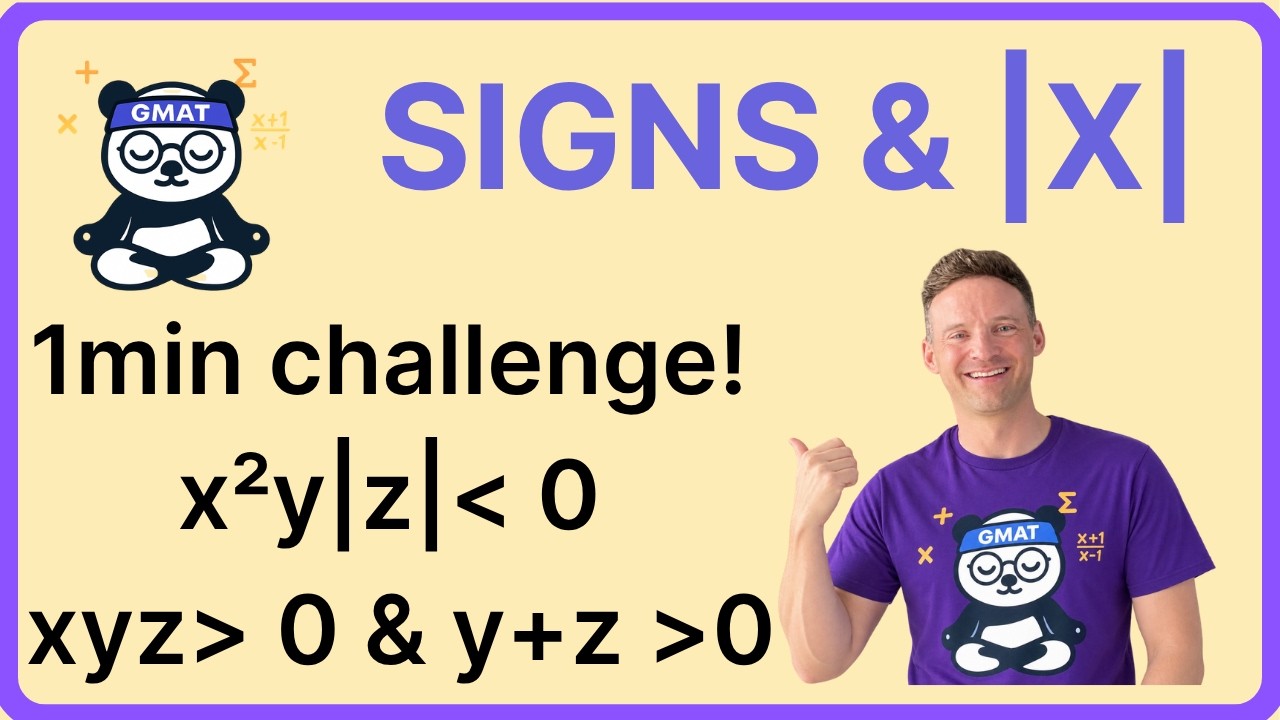
Take x²·y·|z| < 0. Since x² cannot be negative and |z| cannot be negative, and the product is strictly negative, neither can be zero. So both are strictly positive, which forces y to be negative.
Add y + z > 0: since y is negative, z must be positive and large enough to outweigh it. Add xyz > 0: y is negative and z is positive, so their product is negative, which forces x to be negative.
Three signs established from three constraints, with no numbers anywhere.
One warning worth taking seriously: notice the difference between could be true and always true. GMAT questions phrase this deliberately, and finding one case where an answer works is not the same as showing it always works.