How to Prepare for the GMAT with a Busy Schedule
A practical guide to building a study routine, planning your prep efficiently, and staying motivated when the GMAT is only one of several things competing for your time.
Most applicants do not get to prepare for the GMAT in a quiet bubble. Many are studying in parallel with a full-time job, raising a family, or juggling other responsibilities that do not pause just because an application deadline is coming up.
That reality does not have to work against you. A busy schedule forces a kind of discipline and structure that, handled well, can actually make your prep more effective than studying with unlimited free time. This guide covers how to build a routine around your existing commitments, plan your prep so the hours you do have count, and keep your motivation up over the weeks it takes to get there.
If arithmetic is shaky, take the nine-question check before you lock the weekly hours.
For a broader look at what goes into GMAT prep overall, including study hours, resources, and mock exams, see how to prepare for the GMAT. This article focuses specifically on fitting that prep around a demanding schedule.
"The routine you build to study for the GMAT around a full life is the same routine that gets you through business school."
Organization Is Key
When time is scarce, how you organize it matters more than how much of it you have.
Plan a weekly routine and stick to it
Use time-blocking: set fixed slots in your week for test prep and treat them like any other commitment. A routine you can repeat every week is easier to sustain than a plan you have to rebuild from scratch each Sunday.
Study during your most energized hours
Notice the time of day when you focus best, and protect it for your hardest work (Quant, timed drills, anything that needs full concentration). Save lower-energy windows for lighter review.
Focus on keeping the habit going, not on daily self-evaluation
Small, consistent effort compounds. A 2% improvement each day compounds to roughly 4x over 70 days. Judging your progress day to day mostly just adds stress. Show up for the routine and let the compounding do its work.
Make the most of spare time in your day
Small pockets of time add up over a week: flashcards during coffee breaks, an error log review at lunch, a few questions during your commute.None of these need a desk or a large block of free time, which makes them easy to fit around a full calendar.
Do not sacrifice your down time
Keep a hard stop each night, and protect your sleep and wellness time. Take one day off from both work and study each week, and defend it. Prep that eats into rest usually costs you more than it gives back.
Plan Your Prep Efficiently
With limited hours available, where you put them matters as much as how many you have.
Keep exam prep and applications separate
Cover them in separate activities, and where possible, finish most of your exam prep before you dive into applications. When an application idea comes to you during a study session, add it to an idea list and get straight back to prep, without switching modes mid-block.
Make every study hour count
Cap theory at roughly one quarter to one third of your prep time. The GMAT is a pattern-matching exam, so you need to see how theory shows up in real questions to know what actually matters. Skip the kitchen-sink approach of covering every topic equally, and tailor your study time to your own weaknesses instead. Quality of practice beats sheer quantity.
Error logs and flashcards are key
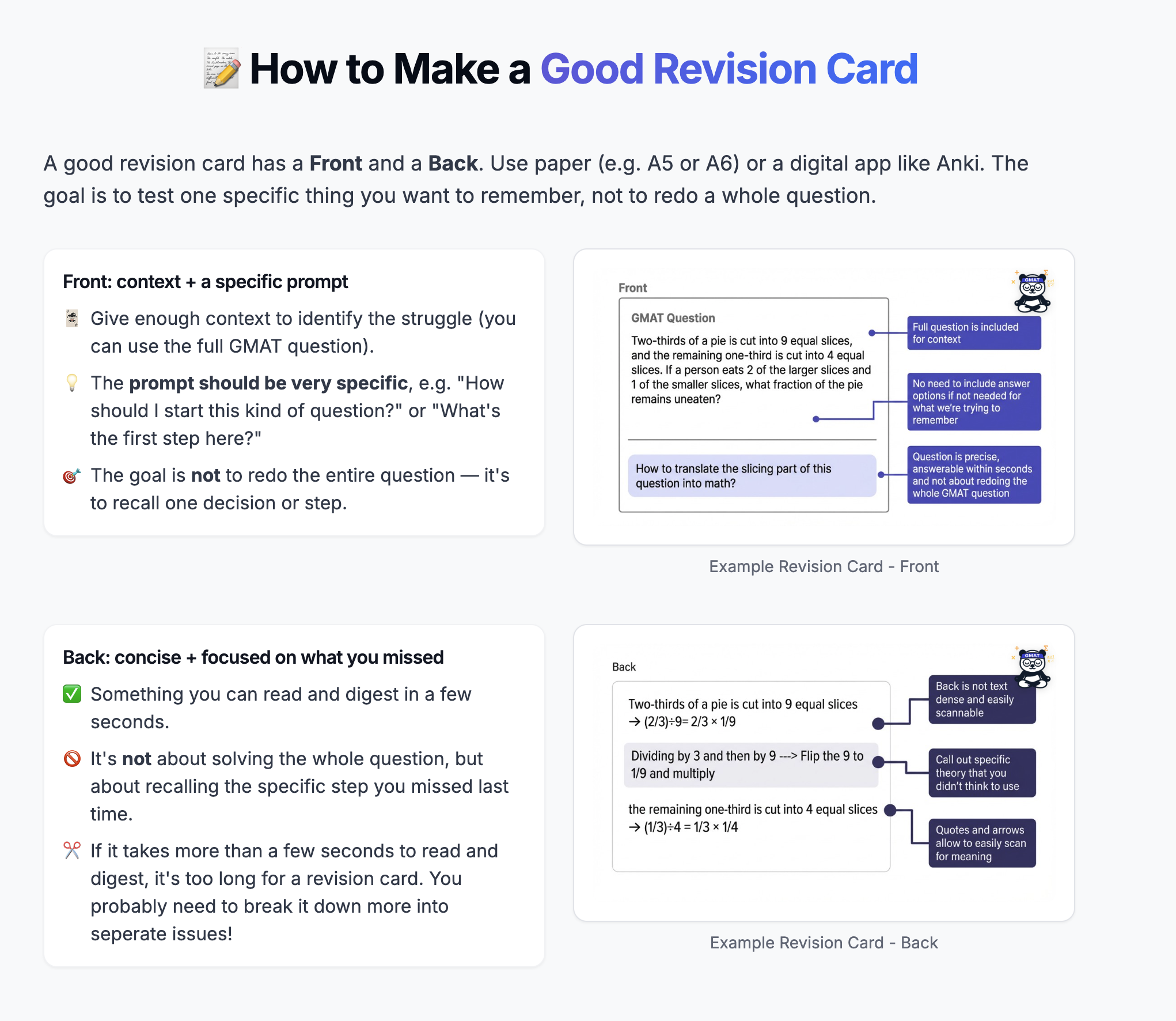
An error log turns mistakes into points by making sure the same gap does not cost you twice. Once a mistake trips you up more than once, turn it into a flashcard so you can recall it quickly, even under time pressure on test day.
Keep Your Morale Up, and Do Not Do This Alone
Weeks of studying around a full schedule take a toll. A few habits make it easier to sustain.
Think about the long-term benefits
Treat the routine and organization you are building as a preview of business school. The habit of protecting focused time inside a busy life is more than useful for the exam. It is a life skill you carry with you afterward.
Adopt a growth mindset
See each mistake as a chance to improve, and as one less mistake you will make on the day of the exam.
Tell the people around you about your plans
If possible, let your boss and colleagues know you are preparing for the GMAT. Staying quiet about it can create extra stress and quietly drain your energy.Let your friends, partner, and family know too, so they understand you will be less available over the next few weeks. You do not need to share your score goals or target schools, just that your time is temporarily spoken for.
Get an accountability partner
Find a study partner or someone else supporting your prep who can help you stick to your plan when motivation dips.
How GMAT Panda Can Help
When your time is limited, every hour of prep needs to be spent in the right place. Here is how GMAT Panda compares with other courses, private tutors, and generic AI chatbots such as ChatGPT and Claude, area by area.
Laser focused diagnostic of your needs
| GMAT Panda | Other courses | Private tutors | AI chatbots |
|---|---|---|---|
|
|
|
|
On a tight schedule you cannot afford an evening drilling a topic you have already mastered. GMAT Panda evaluates your level on a granular, step-by-step basis, and Train mode constantly probes your weaknesses so your limited practice time goes to the gaps that actually move your score.
Feedback pinpointing a specific step.
Train mode, probing your weaknesses.
Theory efficiently bundled into practice
| GMAT Panda | Other courses | Private tutors | AI chatbots |
|---|---|---|---|
|
|
|
|
With a busy schedule you rarely have a spare block for a dedicated theory session. GMAT Panda breaks every solution down into steps and links each one to the relevant tactic, so the theory you need surfaces inside the timed practice you are already doing.
You can click on any step at any time and refer straight back to the lesson behind it, folding theory review into the practice time you already have.
Streamlining your study
| GMAT Panda | Other courses | Private tutors | AI chatbots |
|---|---|---|---|
|
|
|
|
GMAT Panda's calendar sync builds your study schedule around the availability you set, so your prep sits directly alongside your existing commitments. And because flashcards are created automatically from your practice and mistakes, they are simply ready to review during a coffee break or a commute.
Set your weekly availability once, and sync it to your calendar.
A flashcard created automatically from a mistake in practice.
Related reading
Continue with these GMAT Panda articles.
Fit GMAT Prep Into Your Life
Get a personalized study plan that fits your schedule, a diagnostic that focuses your limited hours where they matter, and flashcards that build themselves as you practice.