How to Prepare for the GMAT
A practical guide to what goes into good prep, how long to study, which resources to use, how many mocks you need, and why flashcards with spaced repetition help.
Studying around a full-time job or family commitments?See how to prepare for the GMAT with a busy scheduleWhat Goes Into Good GMAT Prep
Refreshing or learning maths basics
How much you need depends on your background and career so far.Some test-takers need to rebuild foundations; others only need a quick refresh.If you have not used this material since school, start with the free 9-question check, then the GMAT Quant Basics video course.
Knowing GMAT-specific approaches, tips and tricks
The GMAT has its own question types and patterns.Learning the right tactics (e.g. for how to solve a Prime Matching question) is essential.
Knowing when and how to apply the tactics
This is often the hardest part of prep. You can know a method but still miss questions if you don’t recognise when to use it under time pressure.
Putting it all together under exam conditions
Managing your time well and learning certain things by heart so you hesitate less under pressure.Timed practice and a few full mocks are key here.
Plan Your Prep Hours and Resources
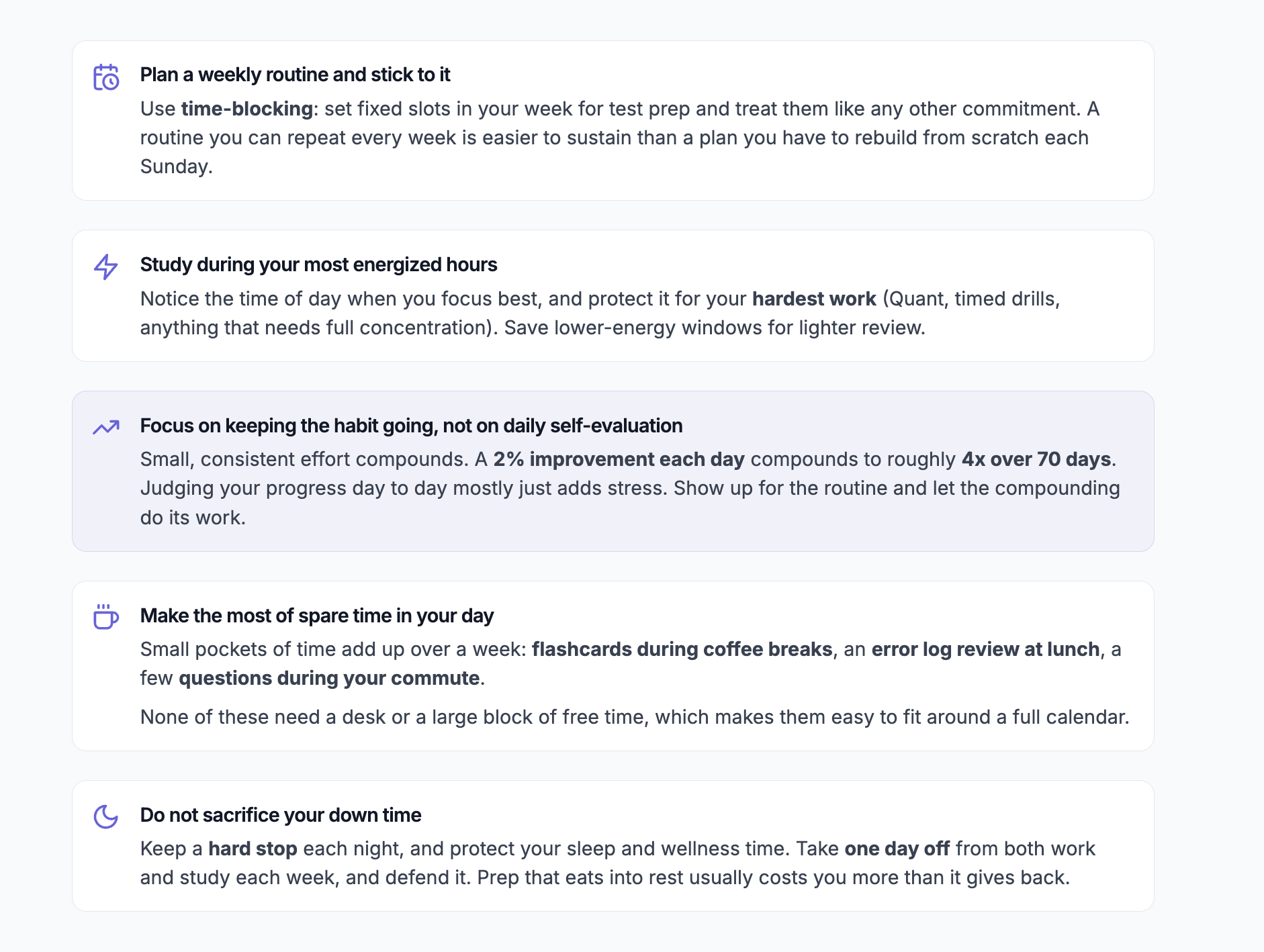
Plan in study hours, rather than months — it depends how much spare time you have.
A typical range is 100–300 hours, depending on your background and target score. Below is a rough breakdown of where your hours go:
- Theory section of the Official Guide
- Your undergraduate or high school notes
- YouTube (e.g. Khan Academy, or GMAT Panda channels)
- Videos and quizzes on a prep app like GMAT Panda
- A few GMAT Exercise questions
- Timed drills using the Official Guide or mba.com
- Timed drills on GMAT Panda (see below)
- Mock exams
- Timed revision cards
| Prep area | Typical hours | Resources |
|---|---|---|
| Refreshing or learning maths basics | 20–40 |
|
| Knowing GMAT-specific approaches, tips and tricks | 20–40 |
|
| Knowing when and how to apply the tactics | 50–200 |
|
| Putting it all together under exam conditions | 10–20 |
|
| Total (approx.) | 100–300 | — |
The Bulk of Your Prep — Timed Drills
Most of your study hours should go into high-quality, timed practice — not endless theory reading.
What are timed practice drills?
| Principle | ✓ | |
|---|---|---|
| Quality sources onlyUse the Official Guide or similar quality (e.g. GMAT Panda). Bad questions are often hard to understand, make you practice topics you don’t need, and in general make you pick up more bad habits than good ones — it’s like learning to drive with Mum and Dad in a car park instead of learning real road skills. | ||
| Timed in batchesWork in batches (e.g. 20 minutes for 10 questions, or 30 minutes for 15). That is not the same as “2 minutes per individual question” in isolation. On the GMAT you often take a different approach depending on whether you can spend about 1 minute or about 3 minutes on a question — you need to practice that trade-off before the exam. Aim to finish on time — not late and not early either (finishing too early leaves brain power on the table). This does not stop you from a proper debrief afterwards, including redoing a question you had to guess. | ||
| Post-processed afterwardsAfter completing a drill, take a short break (e.g. 5 minutes), then come back: check your answers and, more importantly, read the solution even when you got it right. Try to spot anything you could have done better — even a calculation you could have done a bit quicker. Whenever you notice something that could help often, make a flashcard out of it. | ||
| Keep an error log — and redo with intentTrack mistakes and redo questions you got wrong — but redoing without the post-processing above is often ineffective. Most candidates redo wrong questions; fewer do the quality work that makes them likely to get those questions right next time. |
Quality matters most, but a certain amount of quantity is also needed!
The GMAT is about pattern matching, so you need to see enough questions to develop that skill, and for this reason progress is often not linear. So don't worry if you don't see much progress early on.
Aim for at least 150 questions per section before your first GMAT (ideally more; many people keep improving up to 500–600 questions per section).
Count about 5 minutes per question (2 minutes doing it + 3 minutes reviewing). So 450 questions ≈ 2,250 minutes ≈ 37+ hours of drill time alone.
What Difficulty Level Should Your Questions Be?
It is a myth that you need to work only on the hardest questions to earn a 655+ score. The GMAT algorithm heavily penalizes people who get easier questions wrong, so you need to practice those reliably too. For more on how that affects your score, see GMAT scoring.
If you are using official resources, start with easy questions, then work your way up through medium and hard. If hard questions still feel out of reach, focus on getting easy and medium questions right consistently first.
As you get closer to the exam, aim to mix question difficulty. GMAT Panda builds that variety into timed drills so sessions feel closer to the real exam. The exam is adaptive, and you can practice that with our adaptive mocks.
Key Resources
- Official Guide — the go-to for official questions. The theory in the book is often quite crude; pair it with a resource that teaches tactics clearly.
Get the Official Guide on mba.com - mba.com — for more official questions and mock exams. Use the official platform so you’re used to the real interface.
Free Official Starter Kit This contains 70+ free official questions and 2 mock exams. Not everyone knows this, but you can take each mock exam twice without seeing the same questions again (so that's 4 free mocks!). - GMAT Panda YouTube Channel — free tips, tactics, and worked examples.
Watch on YouTube - GMAT Panda app — personalized study plan, timed drills with official-style questions, step-by-step solutions, and built-in flashcards.
Try the app - Non-official resources: be careful about quality.
Bad questions or wrong explanations can do more harm than good by reinforcing bad habits. Stick to materials you trust.
How Many Mocks Do You Need?
Not as many as people often think. What matters more is doing lots of timed practice at exam intensity (around 2 minutes per question).
Taking 2–3 full mocks is usually enough to get used to endurance and exam format; in most cases you don’t need more than that.
- Typically not enough to get familiar with the exam.
- A good rule of thumb.
- 1 mock to diagnose early on.
- 1–2 before the exam after doing many questions.
- Usually not needed.
- Better to do more timed drills of questions (mocks are exhausting!).
| 0–1 mock | 2–3 mocks | 4+ mocks |
|---|---|---|
|
|
|
The Benefits of Flashcards
"Flashcards are often the difference between a good and great score"
Reduce cognitive load
The GMAT is hard and stressful — it’s easy to panic and have mind blanks. Flashcards help by memorising what to do (and what not to do) in certain situations.When you’re riding a bicycle, you don’t think simultaneously about pushing down on the right pedal, lifting your left foot, looking ahead, keeping your balance, etc. You do it automatically from muscle memory. That’s what flashcards do for you.
Not just formulas — use them for mistakes too
If you keep making the same type of mistake, turn it into a flashcard (e.g. “When I see X, I must not assume Y”).A good rule of thumb: if you make the same mistake twice, turn it into a flashcard.
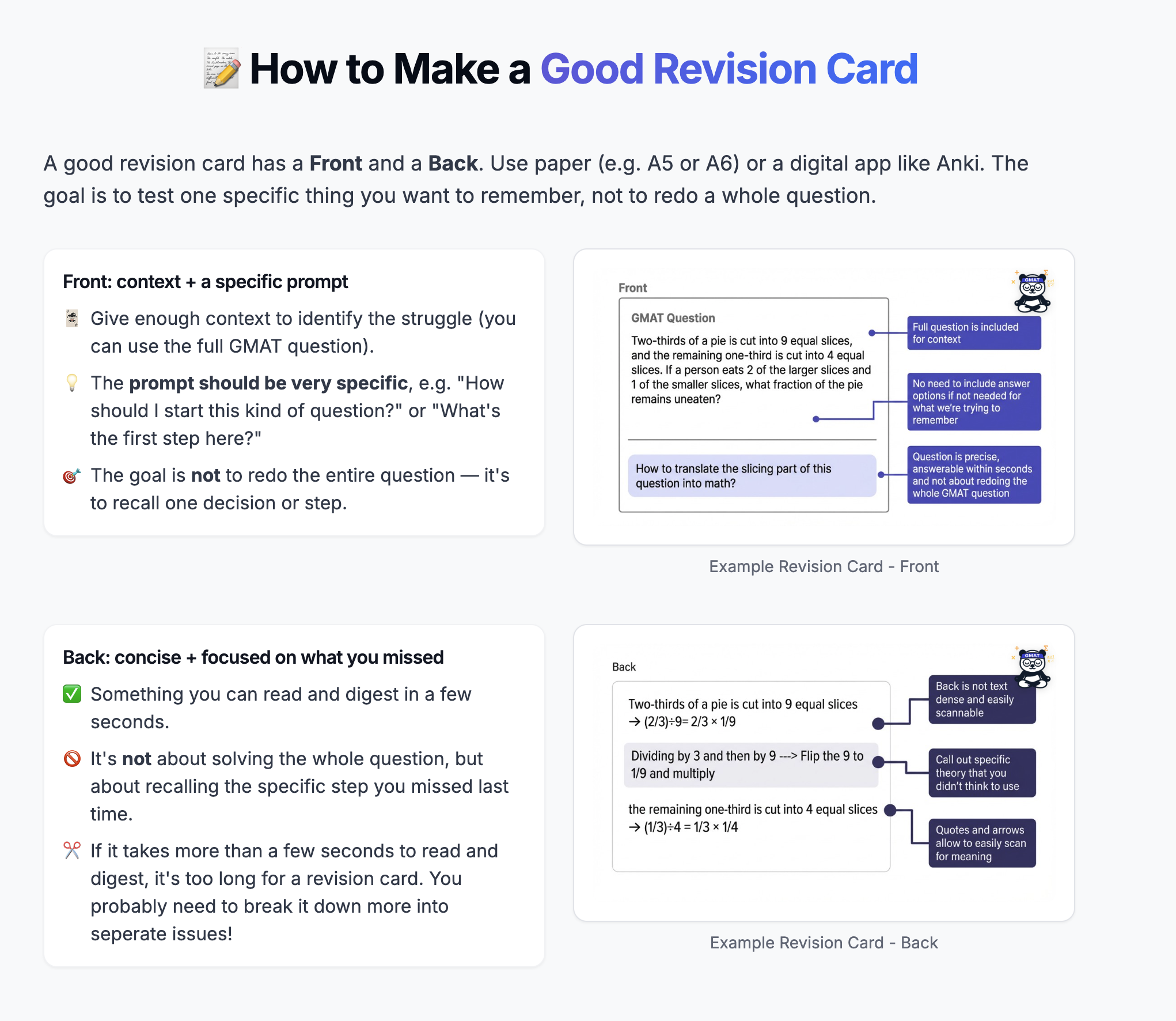
Front and back, not notes
Flashcards are not just notes! There should be a front and a back (the back hidden at first).Otherwise you’re just reading, and your eyes skip to what you already know and gloss over what you don’t.
Use spaced repetition
Review more often the cards you’re less comfortable with, and less often the ones you know well — so you focus effort where it matters most.There are apps for this (e.g. Anki), but GMAT Panda also does this for you.
Related reading
Continue with these GMAT Panda articles.
Ready to Ace the GMAT?
Get a personalized study plan, timed drills, and clear tactics so you know when and how to apply what you learn.