How Is GMAT Scored? Section Breakdown & Scoring Guide
GMAT scoring on Focus turns three section scores into one 205–805 total. This guide covers the GMAT scoring system, percentiles, Classic vs Focus concordance, and how score sending works.
Published · Updated
Key takeaways
- GMAT Focus scores you on a 205–805 total scale, built from three section scores (Quant, Verbal, Data Insights) each on 60–90.
- The exam is adaptive. Your score reflects the difficulty level you can handle, so two people with similar accuracy can score very differently.
- Unanswered questions hurt. Finish every item in the section.
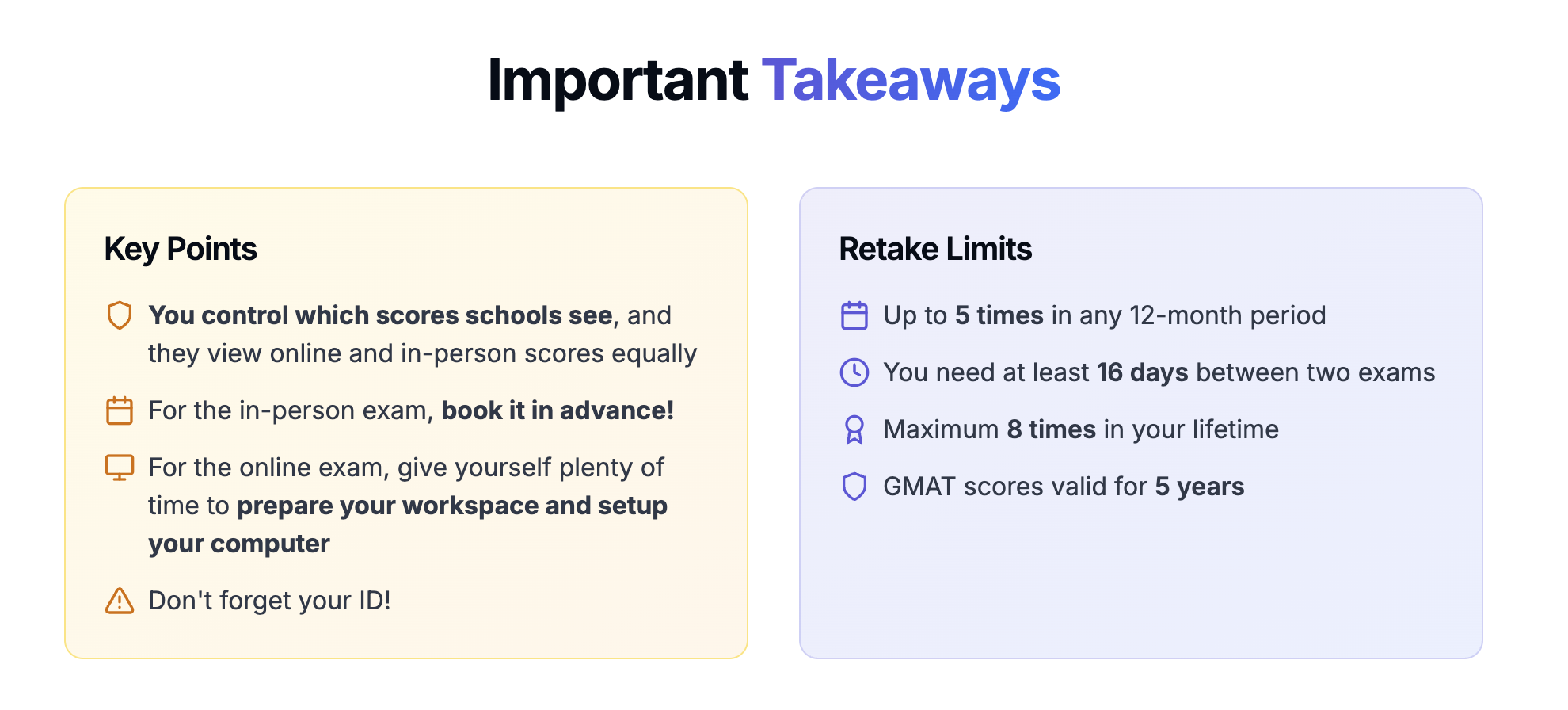
- On Focus you control which scores schools see via Score Sending. You do not need classic-style cancellation to hide a sitting.
The GMAT Scoring System
Think of the GMAT Focus as answering one question: how hard can the questions get before you start missing more than you are getting right?
- The exam measures which difficulty level you can handle under real conditions.
- That is why two people with a similar number of incorrect answers can land far apart on the score scale.
The GMAT is a bit like going to the optician.
Broad checks first ("better one or two?"), then finer clicks until the prescription is clear. Focus does the same: wide adjustments, then finer tuning, until it has an accurate read on your level.
Go deeper
How the adaptive algorithm really moves your score
Streaks, unanswered-question impact tables, bookmarks, experimental items, and Data Insights scoring quirks live in a separate deep dive.
Read the adaptive scoring deep diveSection Scores, Total Score, and Percentiles
The GMAT Focus has three scored sections: Quantitative Reasoning, Verbal Reasoning, and Data Insights. Each section runs its own adaptive sequence and produces a scaled section score between 60 and 90.
Those three results combine into one total score on the 205–805 scale on your official score report.
Score vs percentile:
- The scaled score is what the algorithm estimated from your work.
- The percentile is your standing among peers (what share scored lower than you). It can shift slightly as more people take the test.
Focus total score vs total percentile (GMAC, Jul 2020–Jun 2025 norm)
| Total score | Percentile |
|---|---|
| 805 | 100.0% |
| 755 | 99.9% |
| 705 | 98.0% |
| 655 | 90.5% |
| 605 | 70.3% |
| Total score | Percentile |
|---|---|
| 565 | 50.9% |
| 555 | 47.8% |
| 505 | 27.1% |
| 405 | 7.1% |
| 205 | 0.1% |
Section scaled score vs percentile (GMAC, Jul 2020–Jun 2025 norm)
Focus section scores are reported on a 60–90 scaled range (one-point steps). Example mapping:
| Quant | |
|---|---|
| Score | Percentile |
| 90 | 100.0% |
| 85 | 88.2% |
| 80 | 63.7% |
| 75 | 31.5% |
| 70 | 12.8% |
| 65 | 3.6% |
| 60 | 0.9% |
| Verbal | |
|---|---|
| Score | Percentile |
| 90 | 100.0% |
| 85 | 93.7% |
| 80 | 55.6% |
| 75 | 18.0% |
| 70 | 4.1% |
| 65 | 1.4% |
| 60 | 0.6% |
| Data Insights | |
|---|---|
| Score | Percentile |
| 90 | 100% |
| 85 | 98% |
| 80 | 84% |
| 75 | 48% |
| 70 | 21% |
| 65 | 8% |
| 60 | 4% |
Classic vs Focus Concordance
- The previous GMAT used a 200–800 total scale where scores ended in zero (for example, 720, 750).
- GMAT Focus reports totals on 205–805 in ten-point steps, so totals always end in 5 (for example, 655, 705, 755). School averages may still be reported on mixed or rounded scales.
- When you read older posts, forums, or AI answers, confirm they mean Focus. Mixing Classic and Focus numbers is a common way to set the wrong target.
- Use GMAC's official Focus vs Classic total score concordance when you need to map an older score: gmat-total-score-concordance-table_august2024.pdf. Do not treat a Classic 700 as the same as a Focus 705.
Score Cancellation and Reinstatement
On GMAT Focus you do not need to cancel a score to keep schools from seeing it. After your official score is ready in your mba.com account, you choose which programs receive it through Score Sending. Schools only see appointments and scores you send.
- There is no classic-style "cancel then reinstate for a fee" flow for hiding a Focus sitting you simply choose not to send.
- Separately, GMAC can cancel a score for a testing issue, policy violation, or other good-faith validity concerns. That is different from you choosing not to send a score.
- If GMAC cancels your score, you may be able to appeal within the window in the notice. Possible appeal outcomes include denial, reinstatement of the original score, or another resolution at GMAC's discretion. Check current GMAC policy pages for the latest process.
More logistics live in our GMAT Focus Exam FAQ.
Unanswered Questions and Pacing
Leaving questions blank is typically worse than guessing. Plan your pacing so you finish the section. Bad late guessing can also drag difficulty down and punish easy misses.
For approximate impact tables by section, see the unanswered questions section in the adaptive scoring deep dive.
Timing and Your Score
The number one way to hurt your score on test day is to mismanage your time. That usually matters more than squeezing in a few extra hard questions.
Running out of time: two painful patterns
Both leave you worse off than steady pacing, for different reasons.
Pattern 1: You leave questions blank at the end
- Blanks effectively cap your score and hurt more than guessing. See the unanswered impact tables for approximate section-point drops.
- In the DI score report below, the candidate only made 2 mistakes but scored 81 because they ran out of time and did not answer the last question.
Pattern 2: You guess randomly on the last few
- Random late guesses are better than blanks, but still very costly.
- You will most likely get those questions wrong, and the algorithm will adjust the question difficulty accordingly.
- Your last guesses can land on easy questions. Getting those wrong drags your score down, like in the example below (a score of 76 after an otherwise solid stretch).
For pacing checklists and timers, see our GMAT time management guide.
At a Glance: What Affects Your Score
Impacts your score
- Whether each item is correct or incorrect, based on your final selected answer.
- The difficulty of the questions you answered.
- Unanswered questions that effectively cap your score.
- Correct streaks that push difficulty up, and incorrect streaks that push it down.
Does not directly drive the score
- Experimental items (you cannot identify them; they are excluded from scoring).
- How fast you answer by itself. There are no bonus points for speed.
- Question order as a direct score input. Order shapes later difficulty, but the score comes from your responses and item difficulty.
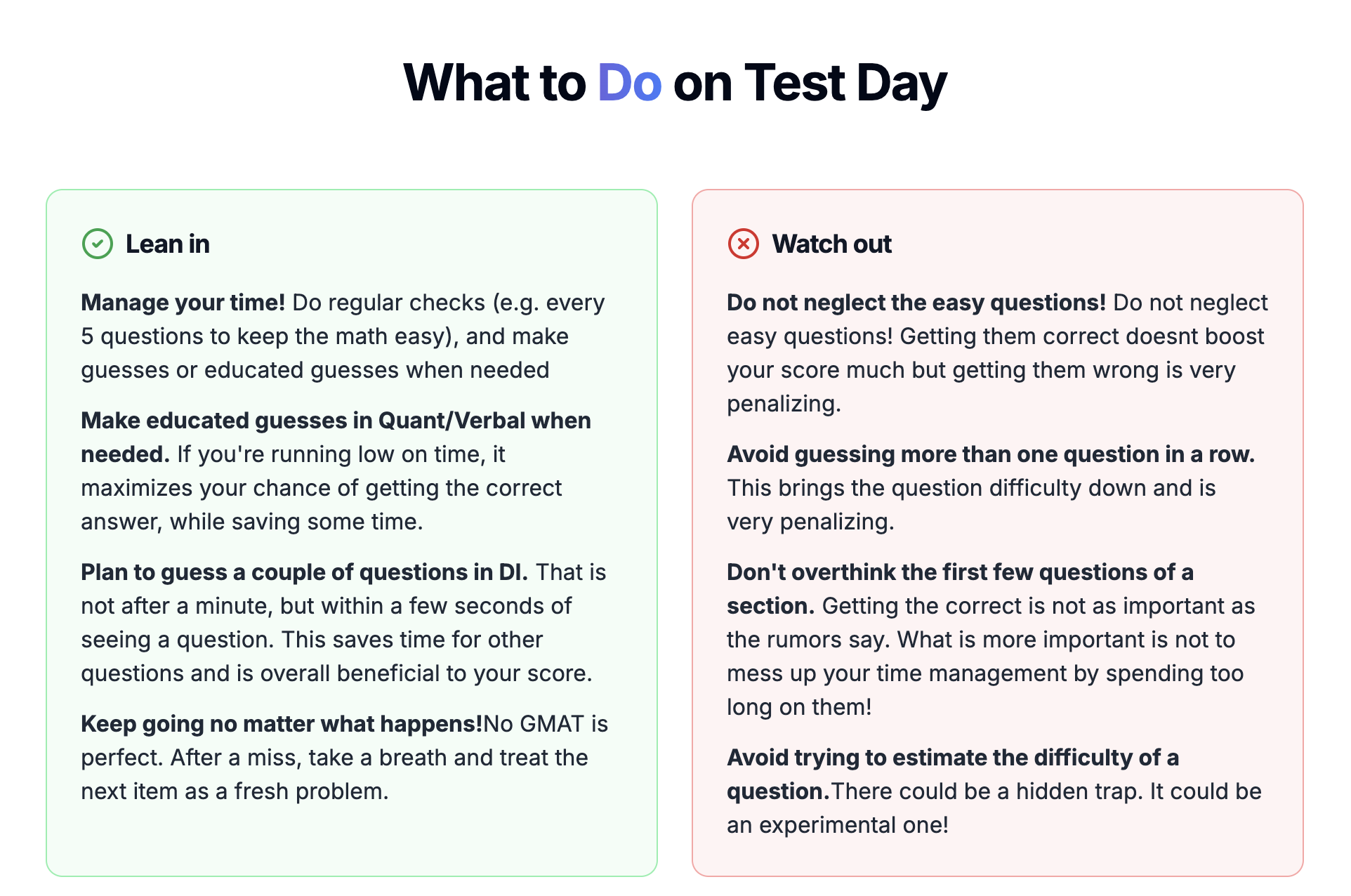
What to Do on Test Day
Lean in
- Manage your time. Check every 5 questions and guess when you need to finish.
- Make educated guesses in Quant/Verbal when you are low on time.
- Plan to guess a couple of DI questions early so you can guarantee points elsewhere.
- Keep going after a miss. Treat the next item as a fresh problem.
Watch out
- Do not neglect easy questions. Easy misses are very penalizing.
- Avoid guessing several questions in a row when you can space them out.
- Do not overthink the first few questions at the cost of pacing.
- Do not try to spot experimental items. Treat every question seriously.
For more test-day tactics, read our last 48 hours before the GMAT guide.
GMAT Scoring: Quick Reference

GMAT Focus Scoring
Key Facts
Three sections, one total
Quant, Verbal, and DI each score 60–90. Your total sits on 205–805.
Score first, percentile second
Schools cite the scaled score. Percentiles give peer context and can drift.
Use concordance for Classic scores
Focus totals end in 5. Map older 200–800 scores with GMAC's table.
You control Score Sending
Schools only see scores you send. Classic cancel/reinstate is not required.
Finish every question
Blanks hurt. See the adaptive guide for impact tables and timing patterns.
gmatpanda.com/content/how-gmat-scoring-works
Related reading
Continue with these GMAT Panda articles.
Train for the Real Exam
GMAT Panda lets you train with adaptive mocks, time management practice, and post-exam feedback on your pacing.