GMAT Exponents From Scratch
Exponents are mostly a set of rules to apply correctly rather than maths to work out. The two places people lose marks are mixing up the add rule with the multiply rule, and mishandling signs when the base is negative.
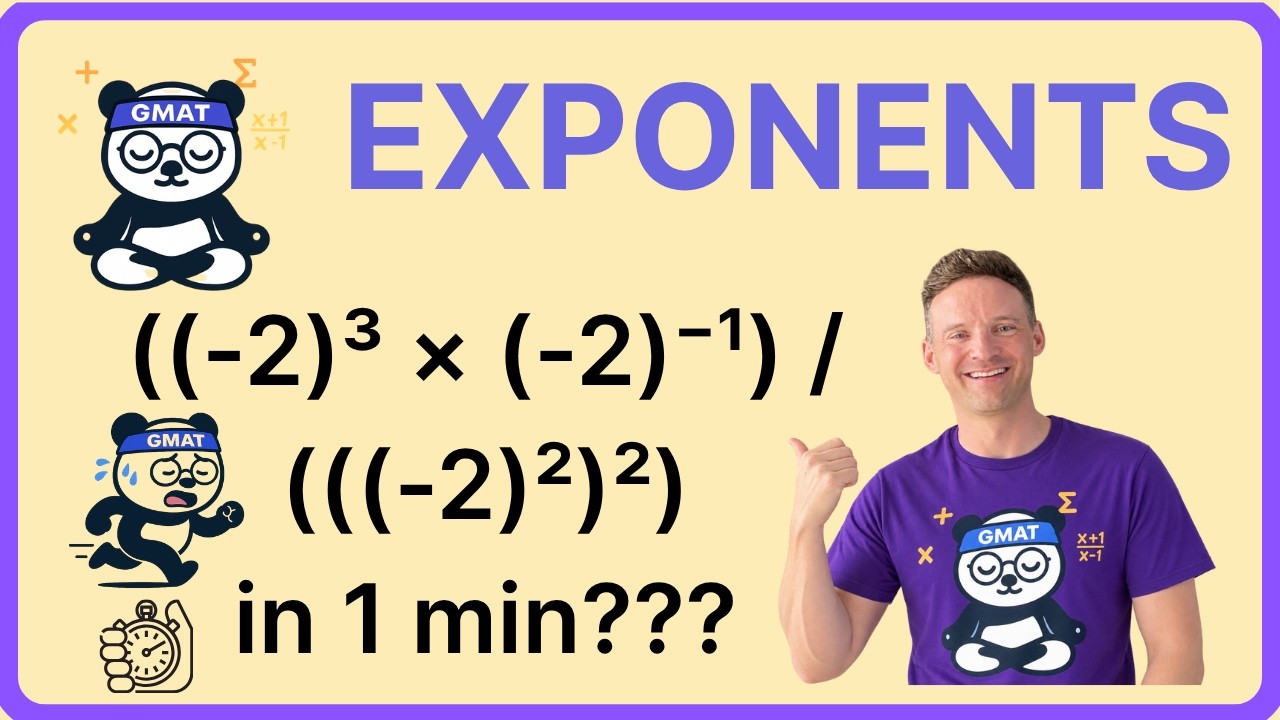
The two rules people confuse
Multiplying two powers of the same base: add the exponents. 2³ × 2⁴ is three twos multiplied by four twos, which is seven twos in a row, so 2⁷.
Raising a power to another power: multiply the exponents. (2³)² is three twos, repeated twice, so six twos in a row, giving 2⁶.
Multiplying gives addition; a power of a power gives multiplication. It is counterintuitive in exactly the way that makes people reach for the wrong one under time pressure. If the rules ever blur, expand a small case out longhand and count the terms. It takes five seconds and it settles the question.
Dividing powers of the same base: subtract. 2⁵ ÷ 2³ leaves 2², because three of the twos cancel.
All three rules require the same base. Different bases stay separate.
A negative exponent flips it
2⁻³ is 1/2³. The minus sign means "move it across the fraction bar", nothing more. It works both directions: 1/5⁻² becomes 5², which is 25.
Any exponent can move between numerator and denominator by changing sign. Positive exponents are easier to work with, so moving them up is usually the right first step.
Two cases to memorize
Anything to the power of 1 is itself. Anything to the power of 0 is 1, not 0. That holds no matter what is inside: (2x + 3)⁰ is 1 regardless of x.
You do not need to understand why for the GMAT. You do need to know it.
Signs: check the parentheses first
This is the single most common exponent error on the test.
When the base is negative, whether the result is negative depends on whether the exponent is odd or even. (−2)³ is negative, because three minus signs leave one unpaired. (−2)² is positive, because the two cancel.
But look carefully at what the exponent applies to. In −2⁴ there are no parentheses, so the power applies only to the 2. Read it as −(2⁴), which is −16. In (−2)⁴ the power applies to the whole thing, giving +16.
Same digits, opposite signs, and the only difference is a bracket.
Distribute across a fraction
(2/3)² is 2²/3². The power applies to the whole numerator and the whole denominator.
The same idea handles composite bases: 21² is (3 × 7)², which is 3² × 7². Breaking a number into its factors before applying the power is often what makes a messy expression collapse.
Delay the calculation
3⁴ is 81, and writing 81 straight away is usually a mistake. Keep it as 3⁴ until you know you need the number. It may cancel against something else later, and GMAT answer choices are frequently expressed as powers themselves.