GMAT Roots From Scratch
Root questions look worse than they are. The symbols are unfamiliar, so people freeze on questions where the actual arithmetic is 2 × 2 × 2. What you need is knowing which operations are allowed, and being fast enough to apply them under time pressure.
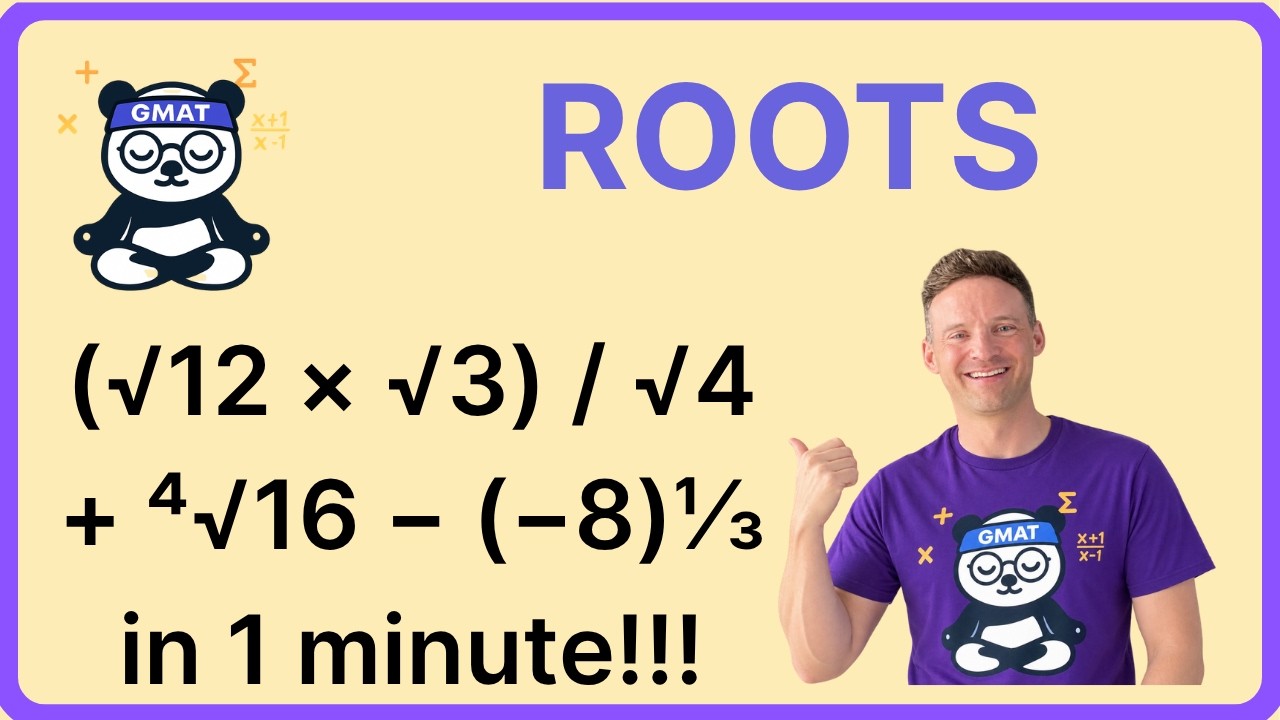
A root undoes a power
The square root of 25 is the number that gives 25 when squared, so 5. The cube root of 8 is the number that gives 8 when cubed, so 2. The pattern continues: the fourth root of 16 is 2.
The square root symbol has an invisible 2. You can write it, and by convention it is dropped. Any other root shows its index above the symbol, which is how you tell a cube root from a fourth root.
Every root you meet on the GMAT breaks down into steps this simple.
Multiply and divide freely, never add
Allowed: √3 × √5 = √15, and √12 ÷ √3 = √4 = 2. Roots combine under one symbol when you multiply or divide, and this often makes the number inside far easier.
Not allowed: √2 + √3 is not √5. This is one of the most common errors on the test and it is worth over-learning.
When you need to add roots, factor instead. √50 − √8 becomes 5√2 − 2√2, since 50 is 25 × 2 and 8 is 4 × 2. Now both terms share √2 and you can combine them into 3√2.
Simplify by pairing factors
To handle a big root, break the number into factors and look for groups.
For √72: 72 is 2³ × 3². The two threes pair up and come out as a 3. Two of the three twos pair up and come out as a 2. One 2 has no partner and stays inside. The result is 6√2.
For a square root you look for pairs. For a cube root you look for trios. Cube root of 54: that is 3³ × 2, so the three 3s come out as a single 3 and the lone 2 stays behind, giving 3∛2.
You will not always clear the root entirely. You will usually simplify enough to make the rest of the question manageable.
Write roots as fractional exponents
√a is a^(1/2). The cube root of a is a^(1/3). The index of the root becomes the denominator of the exponent.
This is worth doing whenever roots and powers appear together, because it puts everything in one format and lets you use the exponent rules. (√x)⁴ becomes x^(1/2 × 4), which is x².
It also handles roots of roots cleanly. The square root of the square root of 16 is 16^(1/2 × 1/2) = 16^(1/4). Since 16 is 2⁴, that becomes 2^(4 × 1/4) = 2.
Signs depend on whether the index is odd
You cannot take the square root of a negative number, because nothing multiplied by itself gives a negative result.
You can take the cube root of one. ∛(−27) = −3, because three negatives multiplied together stay negative. Odd index, negatives allowed. Even index, not allowed.
One convention worth knowing: √9 is 3, not −3. Both 3 and −3 square to 9, and the square root symbol means the positive one.
Two numbers to memorize
16 = 2⁴ and 8 = 2³ appear constantly in GMAT root questions. Recognizing them on sight turns a fourth root of 16 into an instant answer rather than a calculation.