How the GMAT Adaptive Algorithm Affects Your Score
Streaks, blanks, late guesses, bookmarks, experimental items, and Data Insights quirks. The mechanics behind how Focus estimates your level.
For the section scale, percentiles, and concordance, start with GMAT scoring.
Published
What "Adaptive" Means for You
Within each section, the computer adjusts as you go.
- You usually start around a middle difficulty and move up or down from there.
- Streaks of strong work tend to pull the stream toward harder material.
- A rough patch tends to ease the next items so the test can re-stabilize its read.
Section-level adaptiveness ("section bleed")
Your performance on the previous section also has a small impact on the first question you get in a new section.
- GMAC has confirmed this but indicated the score impact is tiny compared with how you perform inside each section.
- We recommend not considering this when picking a section order. (see our section order guide).
Why number of correct answers alone is misleading
Two people can get the "same" number right and still land far apart on the score scale. What matters is how hard those right and wrong answers are.
- High accuracy on only easy work caps the score level you can reach.
- Mistakes on easy questions send bad signals to the algorithm.
Helps your score
- Streaks of correct answers. Getting several correct in a row raises the question difficulty and lets you score a lot of points on harder items.
Hurts more than you expect
- Getting easy questions wrong. It makes the algorithm think you are weaker than your earlier work suggested.
- Streaks of incorrect answers. Getting several incorrect in a row lowers the question difficulty and penalizes you heavily.
Unanswered Questions
A blank question on the GMAT is typically worse than a wrong answer.
- An unanswered question effectively reduces your score by 1/T where T is the total number of questions in the section.
- Below is a table that shows the approximate impact of unanswered questions on your score in each section.
| Quant (21 questions) | |
|---|---|
| # unanswered | Equiv. score impact* |
| 1 | −1.4 pts (~7 percentile pts) |
| 2 | −2.9 pts (~21 percentile pts) |
| 3 | −4.3 pts (~27 percentile pts) |
| 4 | −5.7 pts (~37 percentile pts) |
| 5 | −7.1 pts (~41 percentile pts) |
| Verbal (23 questions) | |
|---|---|
| # unanswered | Equiv. score impact* |
| 1 | −1.3 pts (~9 percentile pts) |
| 2 | −2.6 pts (~25 percentile pts) |
| 3 | −3.9 pts (~33 percentile pts) |
| 4 | −5.2 pts (~38 percentile pts) |
| 5 | −6.5 pts (~45 percentile pts) |
| Data Insights (20 questions) | |
|---|---|
| # unanswered | Equiv. score impact* |
| 1 | −1.5 pts (~7 percentile pts) |
| 2 | −3.0 pts (~21 percentile pts) |
| 3 | −4.5 pts (~30 percentile pts) |
| 4 | −6.0 pts (~42 percentile pts) |
| 5 | −7.5 pts (~48 percentile pts) |
*Equiv. section points = (unanswered ÷ section total) × (90 − 60); percentile drop vs a 80 scaled score using GMAC Quant/Verbal concordance (Jul 2020–Jun 2025) and GMAC Data Insights percentile norms. Your real score move also depends on everything else in the section.
For real score-report examples of blanks and late guessing, see Timing and Your Score in the GMAT scoring guide.
Why Data Insights Feels Different
To do well in Data Insights, understand how the section differs from Quant and Verbal. It tests your ability to process a lot of information under pressure and decide what is relevant.
The section is very representative of typical post-MBA jobs, especially when information is abundant. The ability to sift signal from noise quickly is exactly what employers and admissions committees want to see.
- Four out of five categories of questions require you to answer multiple sub-questions on one page and every one needs to be correct for you to score points.
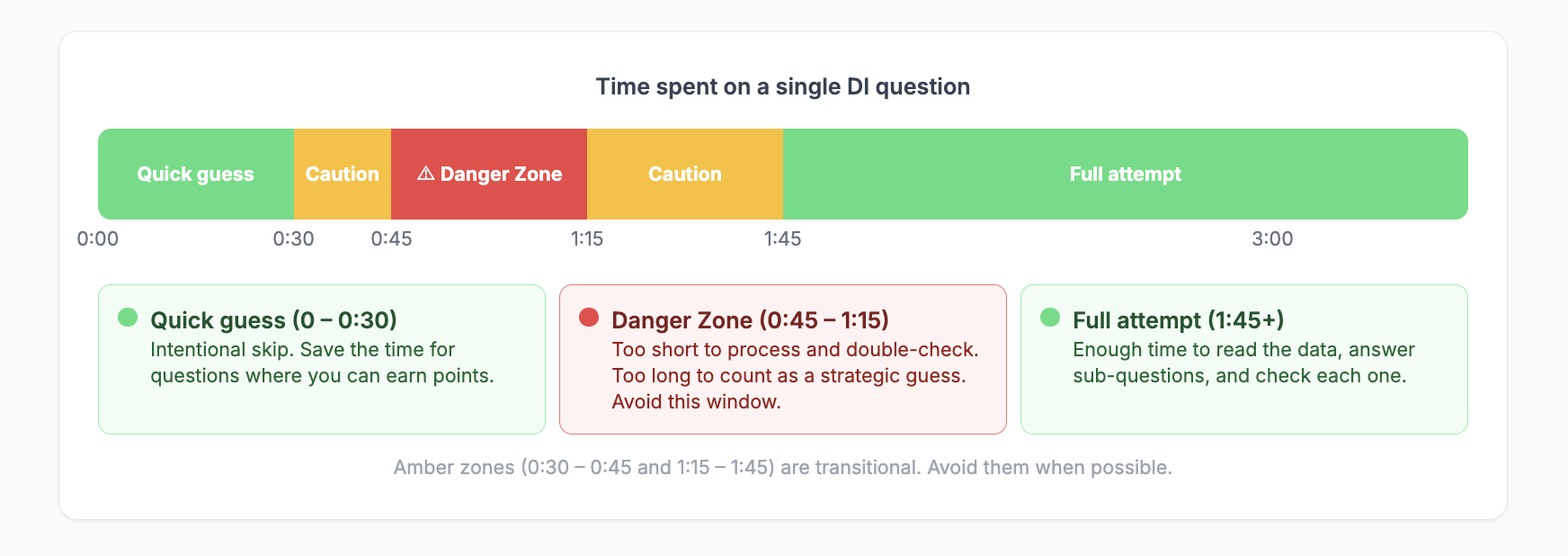
- That is why it is crucial to double-check your answers when you can. Guaranteeing points often takes more than 2 minutes per question.
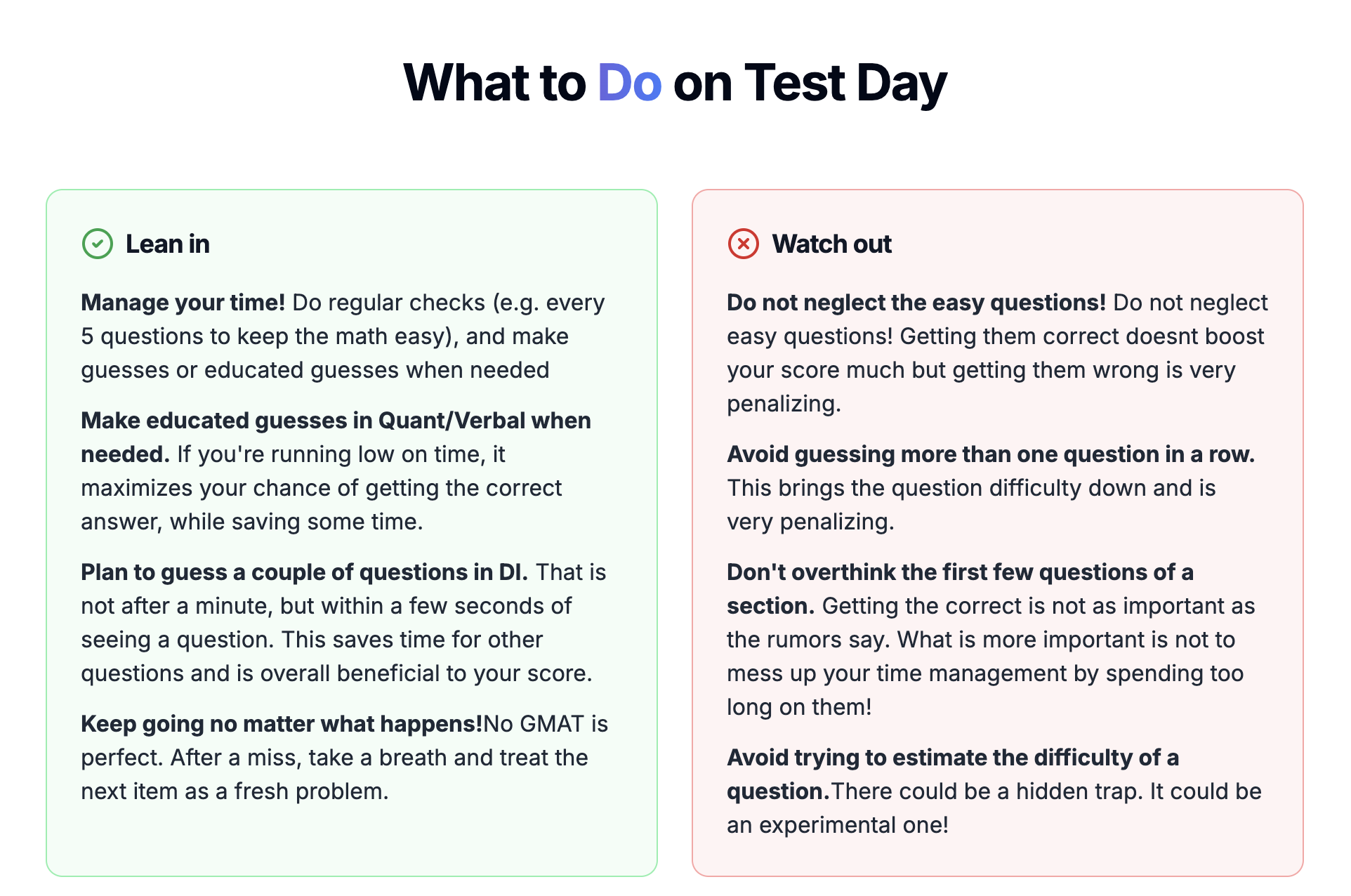
- Spending 30–60 seconds on a DI question is usually not worth it. Guess almost immediately and save that time for other questions.
Here are official GMAC examples of DI question types that require multiple correct parts:
Aim to guess a couple of questions in DI early, and spend that time to guarantee points elsewhere. About 4% of people get the lowest possible DI score (compared with 0.9% Quant and 0.6% Verbal). For more DI tactics, see our Data Insights strategy guide.
Do the First Questions Decide Everything?
There have always been rumors about the first few questions being crucial to the score. GMAC's official position is that the whole exam matters. Our take:
- We do not know the algorithm's exact weights, but we do know that time management is crucial.
- Do not spend too long on the first few questions just to lock them in.
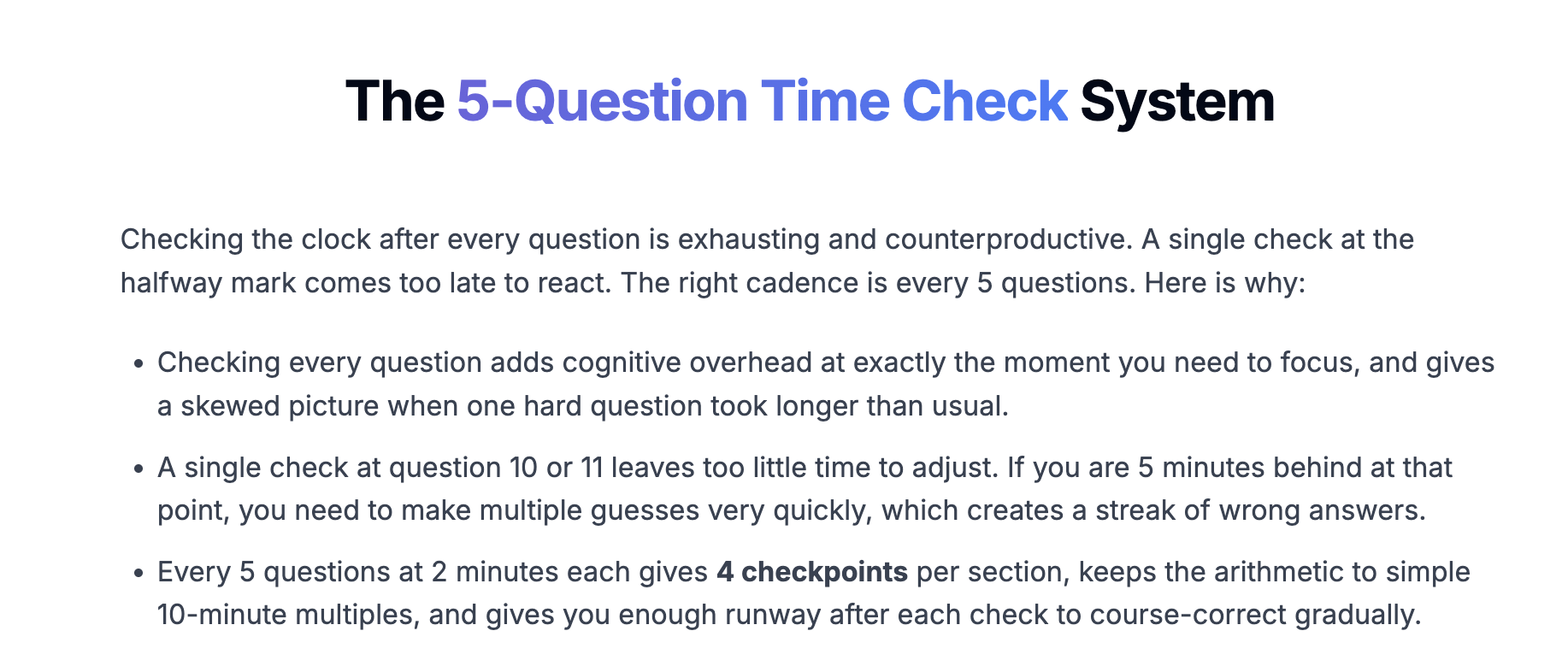
- Steady pacing typically means around 10 minutes on the first 5 questions. Spending 11–12 minutes is fine if you speed up after that. Avoid spending 15+ minutes on the first 5.
Bookmarking, Changing Answers, and Your Score
On Focus, you can flag questions and return to revise. You may change up to three answers per section before that section ends.
What counts for scoring
Only your final selected answer for each question. If you change an option at the end, the engine scores that final choice.
What does not change
The path you already took. Your earlier responses influenced which items you saw and how hard the stream became. Changing an answer does not retroactively replace those past questions or erase the difficulty path you traveled.
Revisiting an answer takes time to switch context. Do not plan to revisit every question. Use bookmarks sparingly when you need them. For example, if you feel close on a question but need 20–30 seconds to wrap up or double-check, flag it and return later.
Unscored Experimental Questions
The GMAT can include experimental items being calibrated for future use. You cannot tell which they are, and they do not count toward your score.
- Do not try to guess which questions these are. That almost always backfires.
- Some questions feel different because they test the same concept in a new way.
- Keep pushing until the end. If a question suddenly muddles you, answer and move on. Tell yourself it could have been experimental.
Adaptive Scoring: Quick Reference

GMAT Adaptive Scoring
Mechanics at a Glance
Difficulty drives the score
Correct streaks raise difficulty. Easy misses and wrong streaks pull you down.
Blanks hurt more than guesses
Finish the section. Leaving items unanswered effectively caps your score.
Late panic guessing is costly
Random late misses can drop you onto easy items, then punish those misses.
Final answer counts
Up to three changes per section. Edits do not rewind the difficulty path.
Experimental items are invisible
Treat every question seriously. You cannot spot the unscored ones.
gmatpanda.com/content/gmat-adaptive-scoring-explained
Related reading
Continue with these GMAT Panda articles.
Train for the Real Exam
GMAT Panda lets you train with adaptive mocks, time management practice, and post-exam feedback on your pacing.