How to Improve GMAT Time Management
Pacing on the GMAT is a distinct skill. Here is a practical system for time checks, educated guesses, and staying in control from question one to the last.
Published
Key takeaways
- The GMAT is designed to push you to your limits. Even strong scorers will feel rushed on some questions. Pacing is a skill that requires deliberate practice. Content review alone will not fix timing on test day.
- The scoring algorithm penalizes unanswered questions and streaks of wrong answers heavily. Running out of time is the most common way to destroy a good score.
- Track time in batches of 5 questions. Use a 2-minute-per-question rule to keep the mental arithmetic simple.
- When you are behind, the solution is educated guesses on upcoming questions, spread out. Bunching guesses at the end is far more costly.
Why Timing Needs Its Own Practice
Most test-takers treat time management as something to fix at the end of their prep. A few timed mocks near the exam, some tweaks, and they assume they will be fine. That approach consistently backfires.
The GMAT is designed to test your limits. Its adaptive algorithm raises the difficulty as you perform well, which means even the best scorers will feel the pressure of the clock on some questions. The GMAT builds time pressure in deliberately. It is part of what the exam measures.
The scoring algorithm penalizes two things particularly heavily: running out of time (leaving questions unanswered) and streaks of wrong answers. Both of these become far more likely when pacing breaks down. See our GMAT scoring for a full breakdown of the impact.
There is also a fundamental difference between answering a question in 30 seconds and answering one in 3 minutes. The difference goes well beyond speed. A 30-second answer often requires a completely different method: a shortcut, a quick estimate, ruling out two or three answers and picking from what is left. These are distinct skills that require deliberate practice.
Think of it like learning to drive. Practicing in an empty car park with a patient instructor builds the basics. It is a very different experience from merging onto a busy highway at speed. Both stages require practice.
Practicing GMAT questions in relaxed, untimed conditions builds understanding. The skills of choosing the faster method, making educated guesses under pressure, and deciding when to move on only develop through timed practice.
The rest of this guide gives you a concrete system for building and applying those skills on test day.
GMAT Timings by Section
Each section of the GMAT Focus gives you 45 minutes. Divide that by the number of questions and you get your average time budget per question:
| Section | Questions | Time | Avg per question |
|---|---|---|---|
| Quantitative Reasoning | 21 | 45 min | ~2 min 8 sec |
| Verbal Reasoning | 23 | 45 min | ~1 min 57 sec |
| Data Insights | 20 | 45 min | ~2 min 15 sec |
One important detail about the on-screen timer: it shows time remaining in the section only. The exam interface displays neither elapsed time nor per-question timing. You have to do a little mental arithmetic to know how you are tracking. That is why having a simple rule of thumb matters so much.
The timer counts down. At the start of Quant you see 45:00. After your first question you might see 42:30. You have to convert that into “am I ahead or behind?” on the fly. A simple mental model makes that calculation fast.
Per-question limits are the wrong mental model
The most common pacing advice is to set a hard limit of 2 minutes or 2 minutes 30 seconds per question and move on when the timer hits it. That sounds logical, but it creates two problems.
- Sometimes the extra 30 seconds on a question is exactly what you need to get it right. A rigid cutoff forces you to guess on questions where you were genuinely close to the answer.
- The better question to ask yourself is “am I still making meaningful progress?” Spending up to 4 minutes on a question is reasonable if you are actively working toward a solution. Cut your losses when you are going in circles.
When people run out of time, the natural instinct is to look back at the questions where they spent a lot of time and conclude they should have cut those off sooner. That is often the wrong diagnosis. Making one or two educated guesses on subsequent questions earlier in the section, while the algorithm was still working with harder material, would have been the better fix. That is a far less costly way to recover time.
The 5-Question Time Check System
Checking the clock after every question is exhausting and counterproductive. A single check at the halfway mark comes too late to react. The right cadence is every 5 questions. Here is why:
- Checking every question adds cognitive overhead at exactly the moment you need to focus, and gives a skewed picture when one hard question took longer than usual.
- A single check at question 10 or 11 leaves too little time to adjust. If you are 5 minutes behind at that point, you need to make multiple guesses very quickly, which creates a streak of wrong answers.
- Every 5 questions at 2 minutes each gives 4 checkpoints per section, keeps the arithmetic to simple 10-minute multiples, and gives you enough runway after each check to course-correct gradually.
Time check tables by section
Each table shows two targets. The theoretical ideal pacing column is the precise timer value if you have used exactly your fair share of the 45 minutes. The easy to remember target uses one simple rule you can calculate in your head:
Easy target formula: treat every section as 23 questions. Timer should show at least 2 × (23 − questions done).
Example: you finish question 10 in any section. 23 − 10 = 13 questions assumed remaining. Easy target = 2 × 13 = 26 minutes left on the clock. Assuming 23 questions across all sections builds in a buffer of 4 minutes for Quant and 6 minutes for DI.
Quantitative Reasoning (21 questions, 45 min)
Easy target assumes 23 questions, not 21. This builds in a 4-minute buffer over Quant's actual runtime, giving extra room in a section where pacing pressure is high.
| After Q | Time used (theoretical ideal pacing) | Timer shows (theoretical ideal pacing) | Easy to remember target (2min rule of thumb) |
|---|---|---|---|
| 5 | 10:43 | 34:17 | 23 − 5 = 18 → 2 × 18 = 36:00 |
| 10 | 21:26 | 23:34 | 23 − 10 = 13 → 2 × 13 = 26:00 |
| 15 | 32:09 | 12:51 | 23 − 15 = 8 → 2 × 8 = 16:00 |
| 20 | 42:51 | 2:09 | 23 − 20 = 3 → 2 × 3 = 6:00 |
1 question remains after the final check (timer ~2:09).
Verbal Reasoning (23 questions, 45 min)
Verbal has 23 questions, so the easy target is exact. Matching the target means you are at ideal pace.
| After Q | Time used (theoretical ideal pacing) | Timer shows (theoretical ideal pacing) | Easy to remember target (2min rule of thumb) |
|---|---|---|---|
| 5 | 9:47 | 35:13 | 23 − 5 = 18 → 2 × 18 = 36:00 |
| 10 | 19:34 | 25:26 | 23 − 10 = 13 → 2 × 13 = 26:00 |
| 15 | 29:21 | 15:39 | 23 − 15 = 8 → 2 × 8 = 16:00 |
| 20 | 39:08 | 5:52 | 23 − 20 = 3 → 2 × 3 = 6:00 |
3 questions remain after the final check (timer ~5:52, ~1:57 each).
Data Insights (20 questions, 45 min)
Easy target assumes 23 questions, not 20. This builds in a 6-minute buffer over DI's actual runtime. DI's true pace is 2:15/Q, so you will need that buffer.
| After Q | Time used (theoretical ideal pacing) | Timer shows (theoretical ideal pacing) | Easy to remember target (2min rule of thumb) |
|---|---|---|---|
| 5 | 11:15 | 33:45 | 23 − 5 = 18 → 2 × 18 = 36:00 |
| 10 | 22:30 | 22:30 | 23 − 10 = 13 → 2 × 13 = 26:00 |
| 15 | 33:45 | 11:15 | 23 − 15 = 8 → 2 × 8 = 16:00 |
| 20 | 45:00 | 0:00 | 23 − 20 = 3 → 2 × 3 = 6:00 |
Q20 is the last question. The easy target of 6:00 gives a 6-minute buffer for DI's slower 2:15/Q true pace.
Example time check
You finish question 10 in Quant. You glance at the timer and it shows 27:14.
- Theoretical ideal pacing after Q10 in Quant: timer should show 23:34.
- Easy to remember target: 23 − 10 = 13 assumed remaining. 2 × 13 = 26:00.
- Your timer of 27:14 is above the easy target. You are about 1 minute ahead. No action needed.
- Keep your natural pace for the next 5 questions.
If instead the timer showed 23:00, you would be 3 minutes below the easy target (26:00). That is the signal to plan one educated guess in the next batch of 5.
What to do when you are behind
1 to 2 minutes behind
Plan to make one educated guess in the next batch of 5 questions. Pick a question where you can quickly rule out at least one answer and make a confident choice. This recovers roughly 1 to 1.5 minutes without creating a streak of wrong answers.
3 to 5 minutes behind
Plan to make 2 educated guesses or outright guesses in the next batch of 5.
Avoid guessing on more than 2 questions per batch of 5. More than that creates a streak of wrong answers, which causes the algorithm to serve you easier questions, and getting easy questions wrong is particularly penalizing. If you find yourself needing to guess 3 or more per batch, it is a sign you should have started guessing earlier in the section.
Guessing Strategy
How likely is a guess to succeed?
The success rate depends heavily on the question type. For Quant, Verbal, and DI Data Sufficiency, you pick one answer from five choices, so the math is straightforward. For all other DI question types, every part of your answer must be correct, which makes the probability of a successful guess much lower:
| Question type | Format | Outright guess | Educated guess |
|---|---|---|---|
| Quant / Verbal | 5 choices, 1 correct | 20% | 33–50% |
| DI: Data Sufficiency | 5 choices, 1 correct | 20% | 33–50% |
| DI: Multi-Source Reasoning | 3 sub-Qs, 3 choices each; all correct | ~4% | ~12% |
| DI: Table Analysis | 5-6 Yes/No statements; all correct | ~3–6% | ~6–12% |
| DI: Graphics Interpretation | 2 drop-downs, ~5 choices; both correct | ~4% | ~11% |
| DI: Two-Part Analysis | 2 selections from ~5 options; both correct | ~4% | ~11% |
Educated guess assumes eliminating 1 of 3 choices per sub-question (MSR) or 2 of 5 options per part (GI, TPA).
Spending 60 to 90 seconds narrowing down options in a DI non-DS question raises the odds from ~4% to ~11%. That same time on a Quant or Verbal question gives you a 50% chance of scoring. When you need to guess on a DI non-DS question, do it in a few seconds and move on.
Which type of guess to use
Rarely time efficient
Spread your guesses out
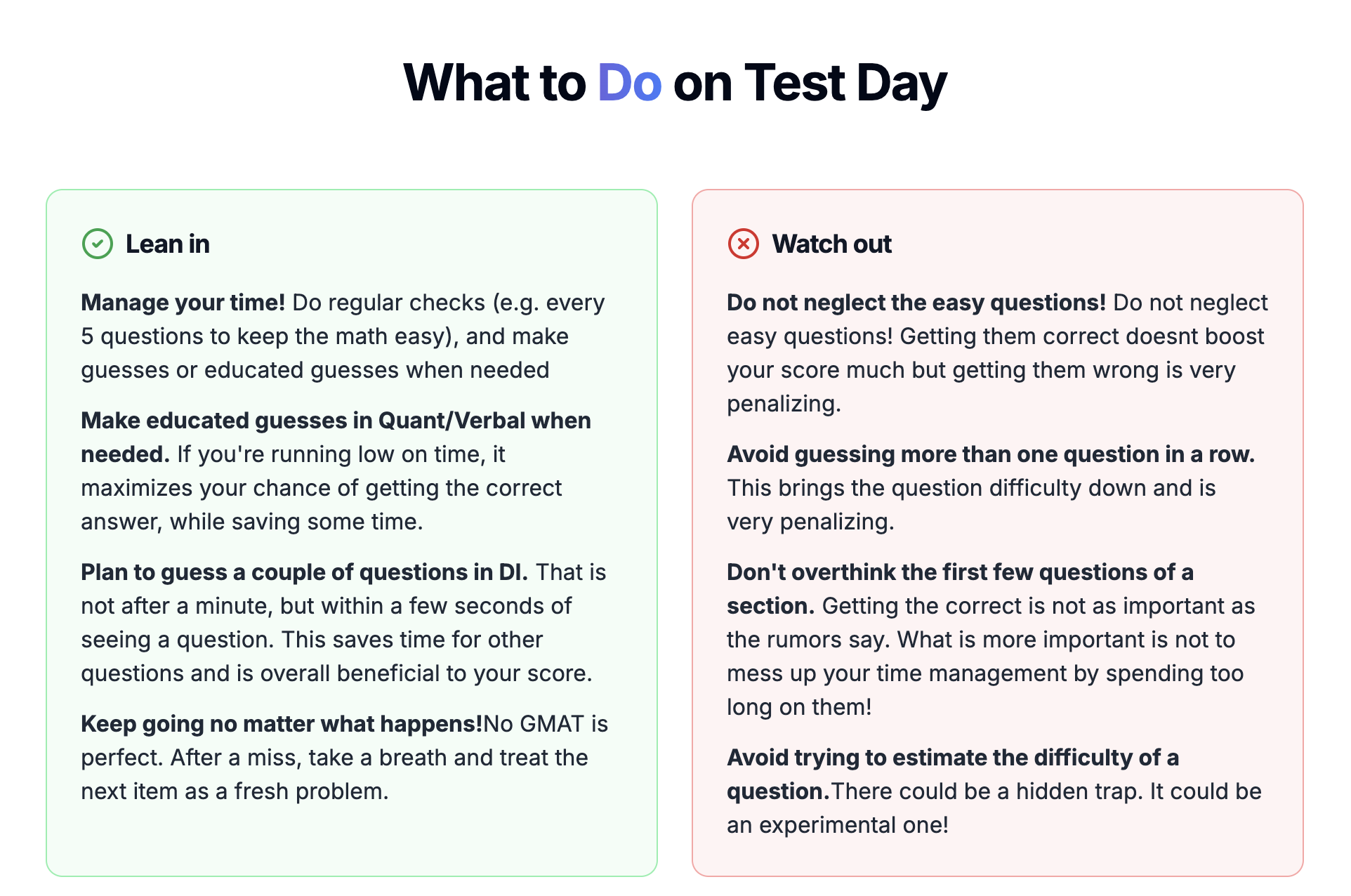
The maximum is 2 guesses in any batch of 5 questions, and they should be spread across the batch. Two guesses back to back create a streak of wrong answers, which causes the GMAT scoring system to lower question difficulty. Getting easy questions wrong is particularly penalizing.
Good: guesses spread across the batch
of batch
of batch
of batch
of batch
of batch
Guesses at the 1st and 4th questions of the batch are separated by attempted questions. No streak risk.
Avoid: two guesses back to back
of batch
of batch
of batch
of batch
of batch
2nd and 3rd questions wrong in a row triggers the streak penalty. The algorithm serves easier questions, and getting those wrong drags your score down.
At a Glance: Pacing on Test Day
Good pacing habits
- Check the timer every 5 questions. Use the 2-minutes-per-question rule to calculate whether you are ahead or behind.
- Ask yourself “am I still making progress?” on every question that is taking longer than expected.
- Make educated guesses early when you fall behind. One educated guess per batch of 5 is a manageable and low-risk correction.
- Practice timed batches during prep. Pacing and guessing instincts only develop under real time pressure.
- Always answer every question. An unanswered question is worse than a wrong answer.
Common mistakes
- Checking the timer after every question. It breaks your focus and does not give you a useful picture of batch-level pacing.
- Setting a hard per-question time limit. It forces unnecessary guesses on questions where you were close, and does not catch the real problem (batch-level drift).
- Only checking time at the halfway point. By then, recovering 5 or more minutes requires so many guesses in a row that it creates a damaging wrong-answer streak.
- Guessing on 3 or more consecutive questions. This triggers the streak penalty in the algorithm. Spread guesses out.
- Blaming overtime on specific hard questions. Later guesses spread across the next section would have been the better correction.
Related reading
Continue with these GMAT Panda articles.
Train for the Real Exam
GMAT Panda builds timed practice into every drill session, so you develop pacing instincts alongside content knowledge. Track your time across batches of questions and get post-session feedback on where your pacing broke down.