GMAT Bootcamp with GMAC: Quant Is Easier Than You Think
By Graeme O'Connor, founder of GMAT Pandaco-organized with GMAC
This page is the full hub for the GMAT Bootcamp with GMAC Quant session: the embedded video, chapter timestamps, and a complete transcript you can read or cite. GMAC co-organized the live bootcamp so candidates could hear practical Quant advice alongside official exam context, then take those ideas into their own prep. For free official practice exams and questions, use the GMAT Official Starter Kit on mba.com.
Graeme O'Connor, founder of GMAT Panda, is a London Business School MBA alumnus (former Student Ambassador) with more than 10 years of GMAT teaching. After business school he worked in strategy consulting at a Bain spin-off, where the same step-by-step Quant habits showed up in everyday client work. He founded GMAT Panda to coach that method in an app, and GMAT Panda sponsors the GMAC Talent and Opportunity Scholarship. If you want to practice the same step-by-step approach after watching, start a free trial on GMAT Panda.
The session walks through common Quant myths, a live word-problem walkthrough, how to debrief with quality, revision cards, and calculation checks, then closes with audience Q&A on prep time, official materials, online vs test center, pacing, note-taking, and calculators.
Practice the method from this session
GMAT Panda breaks Quant solutions into clear steps, builds revision cards from your work, and helps you drill the exact moves you miss.
Full transcript
Introduction and speaker background
Yeah, this is okay. Okay. All right.
thank you. So, well, thank you very much first of all for the opportunity to run this boot camp. So, a little bit about myself.
I recognize a few names in the audience. so, some people may know me, others probably not. I did the full-time MBA at London Business School.
I was a student ambassador during my time there which got me into helping out people on their applications journey and in particular helping them out on the GMATs and I've pretty much been teaching GMAT to some degree since then. So it's been more than 10 years now. I founded a couple of companies.
So one was MBA exchange which was more focused on applications prep. Now I'm focused on GMAT Panda which is a GMAT prep organization. I'm I've been a guest author on a couple of posts on MBA.com and GMAC.com which I will share with you afterwards.
And last but not least, at GMAT Panda, we're a proud sponsor of the GMAC Talent and Opportunity Scholarship, which if you are not familiar with, I would certainly encourage you to look into in more detail. In terms of what we're going to spend our time today. So I want to start off by just debunking a few myths about the GMAT in particular GMAT quant and then we'll jump into an example of a question and we'll try to make this interactive.
So I I'll encourage you to participate on the chats and then after that we'll have a look at a few more slides in terms of the main message that I want to convey to you. and then we have a few sort of like how-to guides afterwards, which we won't go through all of them probably, but depending on what comes up in the example that we do together and what you want to get out of the session as well. So, I'd encourage you, as Victory mentioned, to answer the poll or type in the chat anything that in particular that you would like to know.
and we'll try and tailor that end of the session as much as possible. So in terms of first of all the myths that I want to debunk. So many people sorry are you moving your slides?
Yes I am. do you not see the slide on debunking a few myths now? No we see a slide on quantitative reasoning.
Okay. So let me maybe go back into the PDF. can you see it now?
Yes, we can. Okay. So, I'll I'll not use the full screen mode.
I'll stick to the screen. So, if I if I move down that can you see example question now? Yes.
Okay. Great. Thank you.
Debunking a few myths about GMAT Quant
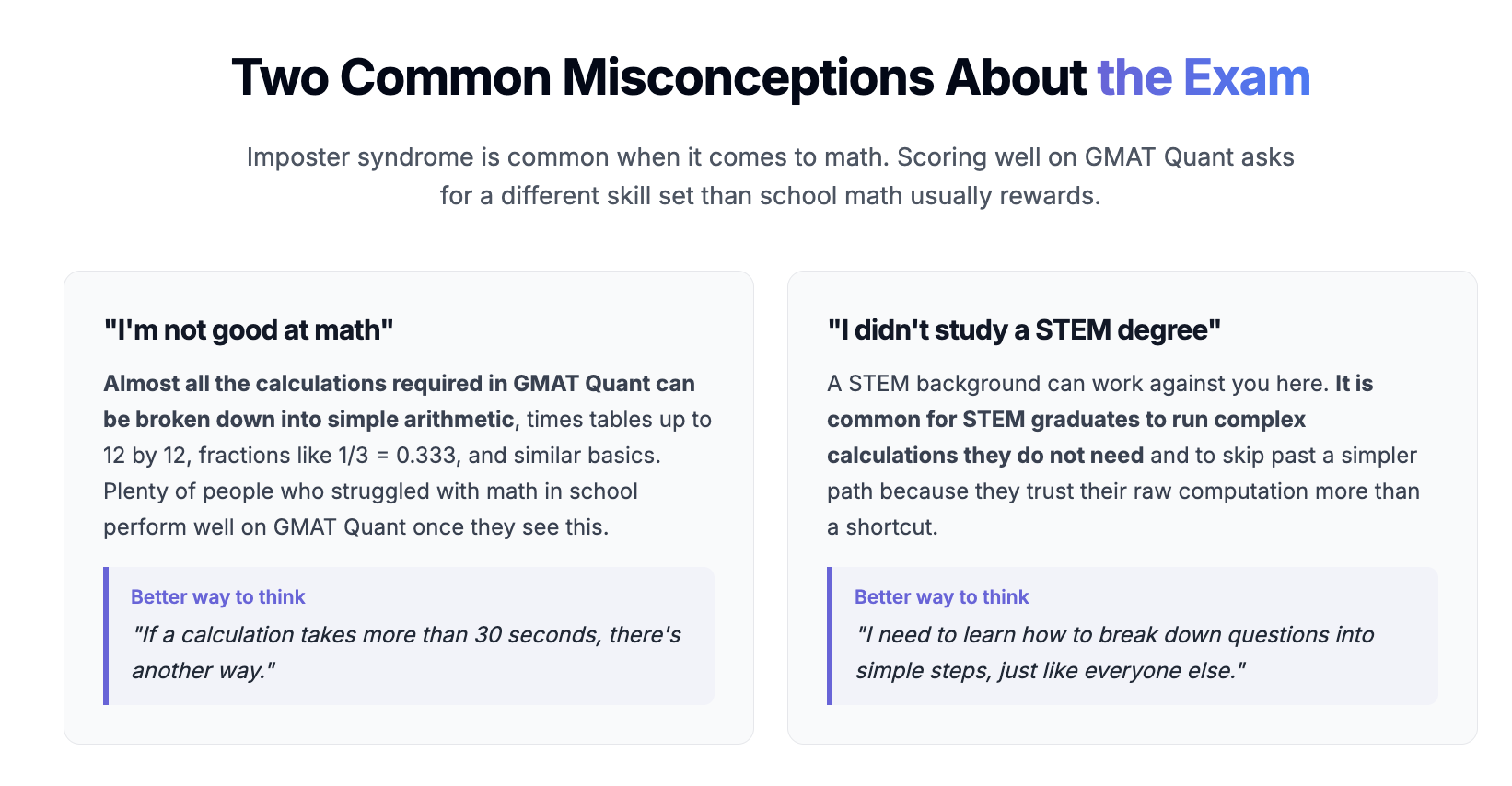
So a lot of people approach the GMAT in particular the GMAT quant thinking well I'm not somebody who's good with math. and having taught the GMAT now for 10 plus years, as I said, I've met a lot of people who don't consider themselves to be good at math. but actually in reality, 99% of the kind of calculations that you need to do if you do things properly are actually very simple.
And what I mean by simple, it's up to the level of your times table. So 12 * 12 or 13 * 13. which most of you will probably have seen at school.
Whether you remember it or not is another question. but it is relatively simple compared to what some people imagine. And actually there are a lot of people who don't consider themselves to be good at math who do very well in the GMAT Quant section.
So what I'd encourage you to think instead in terms of reframing a better way to think about this is if it feels a bit too complicated from a calculations point of view or maths point of view there's another way right and what I typically say is if it's takes more than 30 seconds there's probably a simpler way and this applies to everybody even those who don't don't consider themselves to be good at math. the second one that I hear a lot is, "Well, I didn't study a STEM degree and therefore I'm at a disadvantage." so a STEM degree, if for those who are not familiar, it's a science, technology, engineering or math degree. but actually what I found teaching a lot of people is that often those who have studied such a degree tend to over complicate things.
So rather than looking for simpler ways to break things down, they jump into these complex calculations and often that's that is actually a more difficult way of solving the question and they end up making more mistakes. So a better way to think about this is I need to learn how to break down these questions into simple steps and that is the same for everybody else irrespective of what they studied and you are not at a disadvantage if you didn't study a STEM degree. And then the last one which I often hear is that I want to get the GMAT over it will allow me to get into business school and then these are not skills that I'm going to be using later on.
and having done an MBA, done a quite traditional tract afterwards of doing a few years in strategy consulting at a Bain spin-off, I can tell you that I used the skills that you use in the GMAT, in particular in GMAT quant pretty much every day during my time there and I use them now as an entrepreneur over the past five or six years or so since I've been doing that. And just to give you one example to illustrate. So here there is more examples in the blog posts I work on.
I wrote on I think it was the mba.com one. So again it will be forward to you afterward. as a consultant I had to often present to clients and or clients or partners.
And often what would happen is an analyst would come to me a few minutes before the meeting with a piece of work that they've been working on and they would give me a result and I would have to quite quickly work out whether I was going to share that information with the client or the partner and how I would share it. And so to do that what I needed to do was well a sense checking of their calculations first of all. Does this overall feel right?
And it often required me to make extra calculations for example for imagining other questions that the partner could ask or the client could ask. and all that has to be done in a short period of time under pressure and you also do a lot of breaking down of complex problems in these kind of post business school roles which are actually quite similar to what you need to do in quant where it's about taking a complex question and breaking it down into small steps as we'll see shortly. So a better way to think about this is every GMAT question I do is actually getting you closer to your dream post business school job.
Right? So now we're going to do an
Example GMAT Quant question
Example question and then we'll use that to illustrate some of the further points I have to make. So here is the question. Hopefully everybody can see it.
I'm going to try and copy paste it into the chat in the meantime. have a think about it for a minute or so. The goal is not necessarily to answer the question, right?
But if you can get an answer, feel free to share it. What I'm more interested in is how you would approach this question. So what would go through your mind, what kind of steps you would follow, and how you would do that.
So have a think and feel free to share as you go. on the chat. So even if you are not sure if you if you have some ideas of what you would do feel free to share that right it doesn't have to be perfect on the contrary I am well aware that a lot of people are very early on in their prep or even if you are quite advanced this question is not necessarily Easy.
Okay. So, I can see an answer coming through. thank you.
and a joy. Thank you also for the other people sharing their answers. so good.
We're getting some good answers here. That is the correct answer. Now let's talk a little bit how about how we get to that answer.
So I'm now changing side again. Hopefully everybody can see that with the solution and some bullet points on the side. Victory let me know if that's not the case.
so here
Question solution and walkthrough
What do we have as in terms of a question? First of all this is what's called a word problem which is a quite a general type of problem that you have in GMAT quant roughly a third of them can be considered word problems and what you need to do is translate the English that you have into math. And before you do that, to be able to translate the this English, it's helpful to have some names for what we're talking about.
Okay. So here what we do is we start by naming the various scores involved, right? And in this case we're using T1, T2, T3 for Talia scores on the first, second, and third quiz.
and then R1, R2, R3 for Ravi's. And notice that I'm not just using T and R here because we want to be specific about are we talking about the first score or the second one or the third one. Then afterwards, what we do is we translate the question text.
Okay, so you well the question is on the previous slide, but I've posted it in the chat if you want to have a look at it. you if you look at the second sentence it says on the first quiz Talia score was eight points higher than Ravi score and that we can translate in terms of math as T1 equals R1 + 8. Why?
So if we think about it on the first quiz, Talia score that is something we represent with T1. The verb was is kind of corresponding to the equal sign here. And then we have eight points higher than Ravi score.
So Ravi score is R1, but eight points higher than that would be R1 + 8. Okay. Then what I'm I'm not going to go through every single step here for the interest of time, but what we do afterwards is we translate the other pieces of the question.
So the following sentence and the one after that and that gives us three different equations which we want to then solve to get to the answer. And here it's worth keeping in mind what we're looking for, right? They're asking for Ravi's score on the third quiz was how many points higher than Talia's score.
So we want a comparison between R3 and T3. And what we want to do is actually get rid of everything that's not that. So T1, T2, R1, R2, etc.
And what we use is a technique called substitution to eliminate those other unknowns. And then we simplify what we're left over with to get the final answer, right? And we get R3 is T3 plus 27.
And that means that Ravi score is 27 points higher in T3. And so the answer was E. congratulations to those who said
Why a complex question can be broken down into small steps
That. But putting this particular result and question aside, I want you to take a step back here for a second and just to reflect on what we've done. So first of all, we've broken down this question into around seven or eight steps.
Okay? And in quant that's typical most questions, I mean some of them require a few more steps, some of them are a bit shorter, but that's a typical way to approach things, right? So you want to choose a method, you want to start naming things, giving unknowns, translating the question information.
and then you want to solve things. I would encourage you to look at each individual step that we've used here. And I would argue that actually the maths involved is quite simple here.
Right now, obviously there are more complicated questions, but you can in pretty much all of them break them down into simple steps like this. And each step is more like high school or secondary math rather than what you get in a STEM degree. Okay.
but one reason why people find the GMAT quant section a bit challenging is because they start doing questions and they get quite a few of them wrong. Right? And that's actually because you need to get all of the steps right to get the right answer usually.
Okay. So, what I tend to encourage people to do is to not so much, especially at the beginning, don't focus so much on the percentage of questions you're getting right, right? But focus on the steps.
And there first of all, you'll find that you're getting a lot of steps right even when you're getting the question wrong. Okay? But you also want to make sure that your learnings are based on these individual steps.
Why? Because the GMAT is a standardized test just like other standardized tests where the questions are private, right? You can't know what question you're going to get on the day and it won't be one you've seen before.
However, what I can pretty much guarantee you is that every single of the steps needed to solve those new questions you're going to see, if you've prepared well, you would have seen them in one form or another. So, I would encourage you to turn things around. So, think about these questions on a step-by-step level, but also think every time I make a mistake on a step, as long as I learn from it, I'm less likely to make that same step on the day of the exam.
Okay. The last point I want to make is if we take the example of the second step. So t1 = R1 + 8.
Let's say that when you did this question earlier in your mind or maybe you were taking notes you you made a mistake there. Right? Now writing down on a piece of paper that t1= r1 + 8 is not super helpful in itself.
Right? Because it depends very much on the question and the context. But what you want to do is you want to spend time comparing that to what's written on the left here.
So the actual question text and draw the parallel a bit like how I did earlier between the words and the equation that you're creating. Right? So I always encourage people to think like when they're identifying these steps, it's not just every line of calculation is a new step, but also think, okay, why are you doing that?
And where does this information come from? And sometimes what's helpful is to compare with other similar questions to see what changes and why. Okay.
Now, I like to use a metaphor of cooking when explaining the GMAT quant to people, which may seem a little bit strange, but bear with me a second, right? So, here
You don't have to be a math genius to do well in GMAT Quant
I'm not talking about Michelin star cooks, right? You don't have to be a Michelin star cook to do to cook something at home and it for it to be tasty. Okay?
And usually what people do to do that is they follow a step-by-step recipe. Okay. If you follow a recipe and you bake a cake and it turns out nice, but maybe a bit too sweet.
Well, the answer to that is not to never bake a cake again. Right? or to say, "Well, I'm a failure as a co as a cook.
I should never be doing this." Right? But simply next time when you follow that same recipe, you're just going to put a bit less sugar in. Okay?
Or maybe you're going to check first. did I put what sugar was required and see that you made a mistake and so you correct that for the next time. Okay, it's the same in the GMAT where you should not focus on the outcome especially at the beginning but focus on the individual steps.
when you're cooking you don't always use the same tips and tricks or theory or whatever we want to call it or methods in the same way. So, if you're using an oven, for example, in some cases, you may put it on at 200° for 20 minutes. In other cases, maybe it's 180° for longer, right?
But that depends on what you're cooking, right? And what you've done before, you wouldn't necessarily cook chicken the same way as you cook fish, right? And it's the same here.
When you look at the steps, don't just look at the steps in itself, but think about the context. Think about what happened before and think about the why involved. and last but not least, those who are the best at home cooking, and again, I'm not talking about Michelin star chefs here, right?
but these people, what they can do is they can adapt when they don't have all the ingredients, right? So, if you're following a recipe and you realize you don't have some of the spices you need, you can still produce a good dish by adapting what you're doing compared to the recipe, right? And in the GMAT, it's actually the same, right?
Because on the day of the exam, you will most likely have some slight difference in terms of step involved or context involved. And those who do well tend to well don't panic then, but they rely on the steps they've seen in other similar circumstances to know what to do then. Right?
So, I've looked a little bit of at the questions we've got and we'll come back to them maybe after this. So, it looks like we have a little bit of time. I think 10 minutes, right, Victory, correct me if I'm wrong.
so I'll go through a couple of these how-to guides and feel free to share any other questions you may have in the chat. particularly about what I've said or what, what I could potentially cover in the next few minutes. So
How to debrief GMAT questions: why quality matters more than quantity
One thing that I really want to draw your attention to is the quality of your study matters just as just as much if not more than the quantity. Right? So people often think that to do well in the exam they need to do as many questions as possible and maybe do the hardest ones possible etc.
Right? I would argue that in quant so a certain amount of quantity helps right because it is a pattern driven exam and you want to see these different steps that you can get in different types of question right but typically what I see is your score starts to improve after a few hundred questions as long as you do it with quality all right so what does that mean it means well using good quality questions for a start But it's also making sure that you spend the time to to debrief the question afterwards. And typically what I recommend is you should spend roughly the same amount of time reviewing a question than doing it.
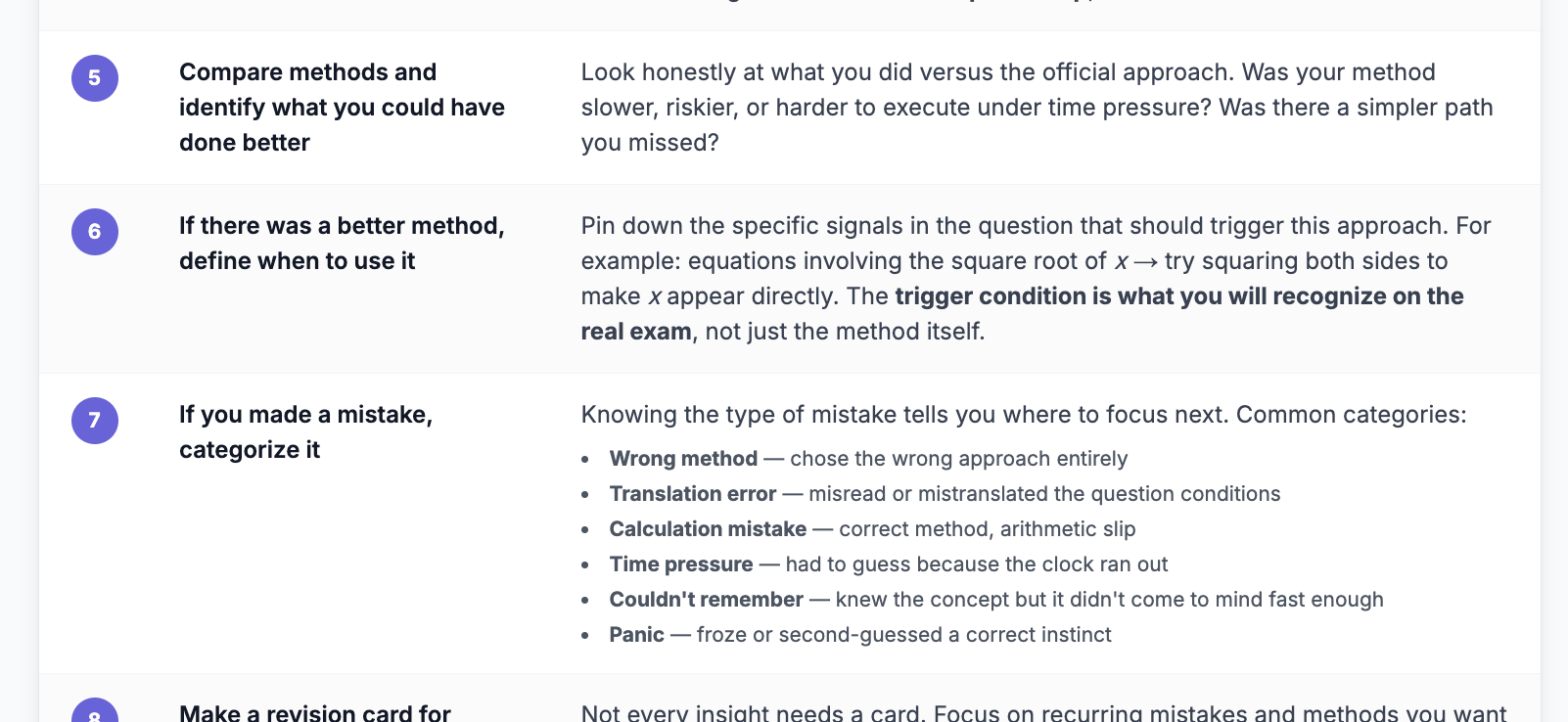
Okay? So you want to go through the answer and even if you got it right, you can still learn from this process. But look at the solution.
look at the different steps involved and try to think okay did I do that could I imp have improved if you could have improved or you didn't do it right we'll think why is the solution doing this what happened before that explains this okay and again don't just write down what you should have done but look at think about the why and the where does this come from Okay. often what people do to memorize things is they take notes, right? They have a word document or maybe an A4 or a book and they just write down notes one after the other.
That is actually has been shown to not be the best way to remember things and learn from things because what happens is that people then just review them and what they do by reviewing is they read them and naturally what your brain is going to do is jump to the things you already know but gloss over the things that you keep on forgetting. So what I tend to recommend instead
The benefits of revision cards and how to make them
Is to use flash cards or revision cards, right? And there are two main differences between revision cards and just taking notes. So one big difference of a revision card properly done is that there is a front and there's a back.
And you can do this either like on paper or you can do it on a app like Anki for example is a well-known one. There are many other apps out there. Why do you want to have a front and a back?
Because the front is essentially giving you the context of what you're trying to remember. Okay. So, here it's an example of a GMAT question where we're cutting a pie in two pieces.
And again, it's about translating that into maths. So, here notice that on the front I put the GMAT question, right? And that's not to redo the question because it's not the goal, but it's more for context, for triggering your memory, understanding, okay, why am I trying to remember this in this context.
you don't necessarily need to include the answers. If that's relevant, then include them. But if not, you don't have to, right?
But make sure that you have a very targeted question, which is the focus of the flash card, right? And here I'm asking how to translate the slicing part of this question into math. Right?
So it's not about redoing the whole question. There is a time for that as well. it's part of a good practice to redo questions you've got wrong for example.
But here it's not the goal of a flashcard. And then on the back it has to be quite short, quite easy to scan, right? And focused on answering that particular question.
and maybe making a link to some theory that you have may have seen before. Okay. here I really cannot stress that it's not about doing the whole question, right?
Okay. so how would you use this? Well, you would take the first flash cards in your pack, right?
look at it and then after a few seconds force yourself to move on to look at the answer, right? And the goal is essentially within a few seconds to remember what's on the back. And this is going to be hard, right?
I'm not going to lie. But it is actually a really good prep for the full exam because you can simulate to some degree the time stress of the exam with a mock, but it's not always quite the same because you know it's a mock, right? Whereas here you're you're challenging yourself to remember what's on the back within a few seconds.
Right? So that little bit of time pressure actually simulates quite well the the different steps and the decisions you have to make in the exam in a short period of time. And then the other advantage of a flash card is that it's separate from all the rest.
So now, depending on how well you did, you can put it at the front of your pack if you didn't remember it at all, for example. Or if you remembered it really well, you can put it at the back, or if it's somewhere in the middle, you can put it somewhere in the middle of your pack. That way, you practice inherently more the topics that you're struggling with more than others.
You can also make flashcards on mistakes, right? So, I'd encourage you especially if you make a mistake more than twice, a similar type of mistake, make a flash card out of it, right? Put the question plus what you did on the first on the front and ask yourself, what did I do wrong here?
Right? This will train you to spot mistakes as you make them and correct yourself. And then when you have something similar in the exam, you'll think, oh, I need to be careful here about that sign problem that I often have.
so I think Victory, how we doing for time? maybe give me a heads up in the chat or on the, or thumbs up or thumbs down. in the meantime, I was going to start answering a few questions.
I've got one more slide to show if that works for you. Yeah. Yeah, that's fine.
Okay, great. so
How to avoid silly and calculation mistakes
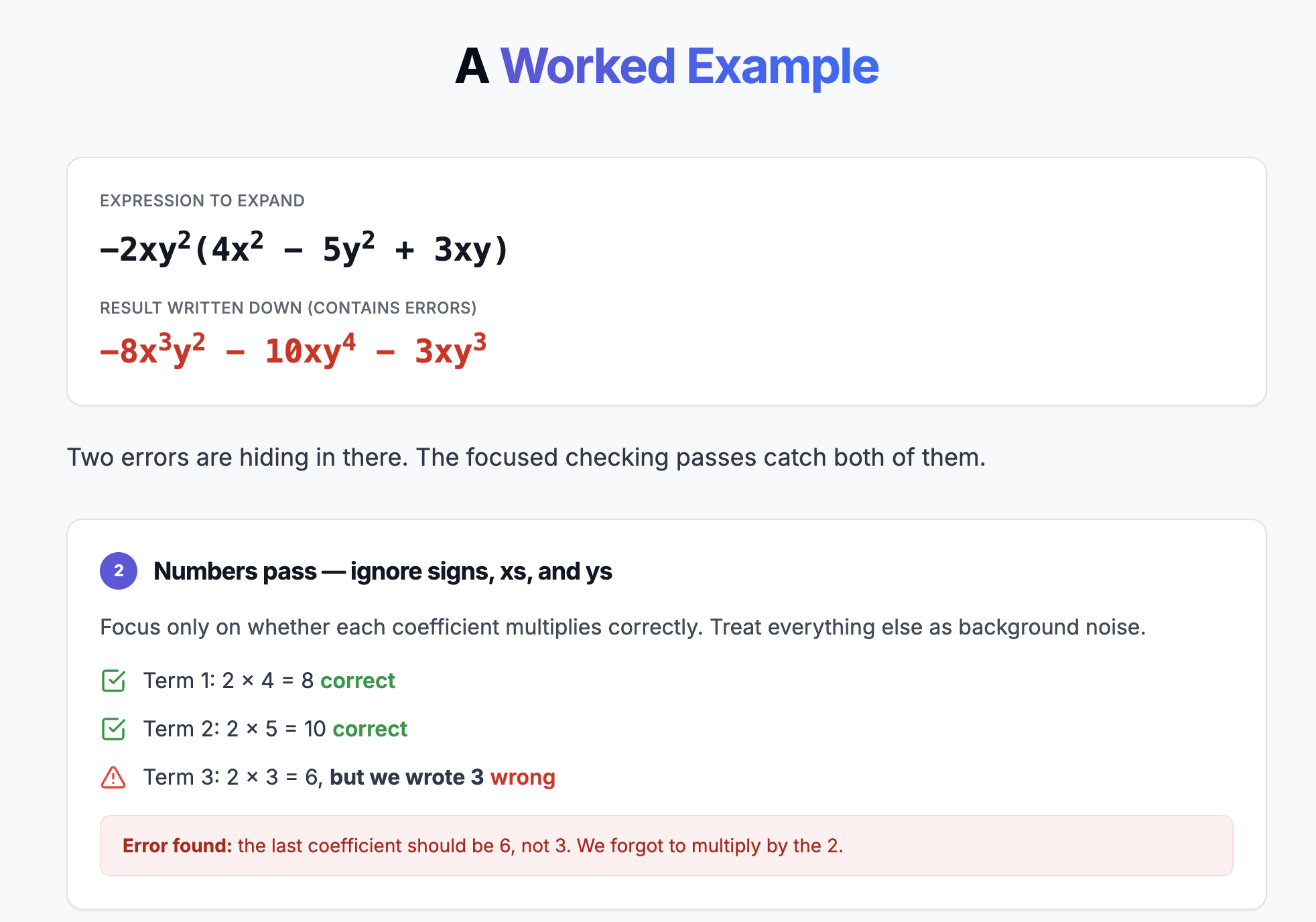
One problem that people have in the GMAT in in quant in particular is that they find themselves making silly mistakes under time pressure right or it's not even silly mistakes it's just calculation mistakes and here one trick that I teach people I work with is well first of all to keep in mind that it's perfectly normal to double check if not triple check your calculations. Okay, this happens to the people who score very highly in quant and in the GMAT as well. Right, I'm a I scored 99th percentile 10 years ago.
I've been teaching GMAT for the 10 years. I still double check my calculations and sometimes triple check them. And the trick is actually to focus on checking one thing at a time, right?
So you can play along here if you want. but the if you look at the expression in black, all right, let's say that's a calculation that we're doing, right? And then on your notes, the next step you write down the one that's in red.
And there are some mistakes in that actually. And if you want to have a go at trying to look at them, please feel free to play around as we go. All right.
but what the trick is here what I really recommend is to think about the individual calculation bits as separately. Right? So here for example we have signs we have x's we have y's we have numbers what I encourage people to do is to think about those separately.
So first of all if we look at the signs right we're multiplying a minus times a positive in the first calculation. A negative * positive gives us a negative. So that is correct.
Right? Notice that I don't care about the two, the four, the x, the y's, etc. when I'm doing that, right?
When I go from when I do the next one, I do minus time minus. All right, that should be a plus. All right, so this minus here is wrong.
Okay, so that's one of the errors here. Now then afterwards, so I finished the negatives and then I move on to something else. So I do the numbers, right?
2 * 4 is 8. That's correct. 2 * 5, that's 10.
That's correct. 2 * 3, that's six. This is incorrect, right?
We found another mistake. Okay. And then we would do the same for the number of x's, the number of y's, etc.
And in this particular case, there are no issues. Okay. But if we if I tried to do that all at once, especially under time pressure, there's a very good chance that I would have would have made a mistake on that because nowadays I mean the human brain is not good at multitasking, right?
And especially under time pressure, you really want to keep things as simple as possible. And trust me, even the best scorers need to do this kind of thing to make sure that their accuracy is good enough. And yes, it will slow you down, but you can speed up by other means first of all, but also particularly at the beginning, spending a few 30 seconds more to double check things will improve your accuracy a lot and it is worth the effort compared to spending two three minutes on a question and just getting it wrong because of a silly mistake.
Okay, so I'll now I think we're
Q&A
Moving over to Q&A. if we have a bit of time at the end V Victory let me know and I'll I'll show a quick slide on GMAT Panda otherwise we'll include it in the email. so I think I saw one question earlier on in terms of the ideal timeline from for the prep from Harshad.
so here it depends it depends a lot on your starting point right. some people need to refresh more the theory and basics than others. in general what I tend to recommend is 100 to 300 hours for the whole GMAT.
So in quant that could be a third of that. It could be more if it's a particular weakness. the key thing that I would say though is do not spend too much time just on the theory because as we saw earlier formulas you may use they don't actually mean so much without the context around.
Right? So it's it's quite different from math that people did at school where you're learning a method and you're you have an exam or test that's quite similar to what you did in class. Here understanding the context and the why behind is more important.
So what I tend to say is avoid spending more than a quarter of your time just on the theory, right? You want to really start doing actual GMAT questions, right? sooner rather than later because then you actually see where that theory is used in practice and you can always come back afterwards to particular theory points and then it'll be much more useful because you'll see where they how they're used in actual questions.
Okay. I think one I guess one thing that I would say is you want to aim to do a few hundred questions in quant alone, right? And if you count two minutes to do them plus two minutes to review them, right?
You can do the math, right? So that's four minutes per question, couple of hundred questions is going to be 800 minutes or so. That is something like 13 hours or so if my GMAT quant is correct.
but that's just for the questions alone, right? You also want to add in the theory. you want to add in the some mocks and 200 questions is a minimum.
You like if you can do 500 because you really want to have a great GMAT score I would and you have the time to do so I would encourage you to aim for that as well. Thank you so much. So we have another question on the Q&A box.
So please if you have questions go ahead to drop it on the chat or in the Q&A box. All right. So the next question is, "Thank you for the amazing and informative session.
I use GMAT club for drilling down a topic, but it's like I'm going down a rabbit hole. How do I become more precise in selection of the level and success and sources? Also, is it true that GMAT mock exams are on the easier side as compared to the actual GMAT?" so I think I missed one word in what you said or is this being sent directly to you?
Maybe it's not in the it's in the Q&A. I can just type it straight up to you. If you don't mind me because I miss the middle bit.
okay. So, let me answer the second one because I understood that. So, the GMAT mocks are fairly representative to the real exam.
they're very that some people find them a bit easier, but that's more because of people tend to prepare for the GMAT, thinking about the question as a whole in general and not using this step-by-step method that I tend to recommend people to use. Right? So if on the day of the exam, since these are new questions, there will often be a different step that you need to throw in at some point in a question that otherwise may look similar to what you've done, right?
Or maybe sometimes it's the start, the initial step that looks different and therefore you're not quite sure how to start, right? But 99% of the time it's just that you've seen those steps just in another context. and it's how you've prepared that you haven't actually seen those steps.
the proper way. That's usually the issue. Right now, there is other thing, one other thing that's worth mentioning is that statistically the GMAT has to beta test some questions, right?
Because they're they're constantly renewing their library of questions. And to do that, they have to throw in a few questions that actually don't count to your score. So, typically it's one or two per section, which don't count, but they may be a bit new.
So, they're testing it on you first to see how well you do, right? and this is just part of their process of keeping the exam up to date and and fresh and sort of maintaining the quality of the exam in terms of the first part. So I'll read it now.
So I use GMAT Club for drilling down topic what it's like I'm doing a rabbit hole. How do I become more precise in the selection of the level and sources? well I mean I would say that the easiest thing to do in terms of using questions is to use the official ones from the GMAT right so either via mba.com or the official guide I think it's on GMAT club it's not everybody knows this but the thing to keep in mind is the people who run this are passionate about the GMAT right and they're passionate about maths as well and they do tend to set challenges for themselves or for other people, right?
So, they do tend to have some quite niche or over complicated questions on there, right? Now, you also get some official questions on there, right? but it's not always easy to cipher through which one's which.
yeah, I would just take that with a little bit of pinch of salt because it's the goal is not to become a math genius, right? It's just to have a good score in the GMAT and that is often about breaking down the problem into simple steps and if you change the exam the source of your questions then you may not get the same steps or mechanisms that you need to learn for the exam. Thank you.
We have another question. thank you so much for the session. Your advice really helpful to me.
My question is would you recommend to do the actual GMAT exam online or offline? H so I actually have a slide on that because it is a recurring question. Am I okay to share again Victory?
Okay. Yes, please. Can I just ask the last question so you could just answer the two of them together.
Okay. The next one is how can we improve on the time take for each question and how can we keep track of the time during the exam? So yeah over to you.
Okay. So, let me I was going to raise the hand. No, that's not needed, I think.
I'll share my screen instead. okay. So, hopefully that should be now visible again.
Yes. so G G online versus offline. Okay.
Well, I would say that for most people nowadays, online is the preferred way to go, but it's not the case for everybody, right? So, it depends a little bit about what puts you in the best situation to focus. Okay?
So, online there are some pros. You can do it at home in a family setting, right? you can book often quite last minute, right?
You can't book it like just the day before, but usually within a few days you can find some slots. Okay. however, there are some issues is that if something goes wrong from a tech or an environment point of view, that's on you, right?
So, if your Wi-Fi drops out or if I don't know a noisy flatmate or a family member walks in at the time, that can be disturbing and you can also be accused of well cheating, right? if there's any noise around because well online obviously the GMAT has to be very careful about maintaining the quality of the exam and make sure that it's fair for everybody right so they will check at the start and then during a few times during the exam so they will check that your there's nothing around your space your desk is clear that there's nothing around you that you could use to cheat on Right. and they will ask you to show your whiteboard or digital board, sorry, your whiteboard every now and then and erase it.
they're essentially doing their job, right, for maintaining the quality of the exam, but it can be a little bit distracting for some people, right? Whereas the advantage is on in person. So there you have to book it earlier earlier on and you have to get there, right?
So you have to plan your transport etc. For some people it's it can be a long journey. but once you're actually in the room, you've checked your ID, you've put everything in, you've emptied your pockets, right?
At that point, you're in the room and you're much less likely to be, disturbed, right? And if there's a Wi-Fi issue or an internet issue or technical issue, that's something that the GMAT will sort out. It won't affect your own exam.
Okay? So it is worth considering the pros and cons of both. The other thing I would say is that like for some people find it more daunting to be in a in a exam room right because nowadays not everybody's used to it.
It was more common before co right now it's things have changed a little bit. but those are the things I would say. Now if you're still hesitating I wouldn't overthink it.
just pick one and then if you have to retake it then maybe you could try the other way the next time. Thank you. So we have just Sorry.
Yeah. Yeah, we have another question. We have two more questions and I think we have just two more minutes left.
Do you mind if I Yeah. Yeah. There was one about how do we improve on the time for each question and how can we keep track of the time during the exam?
And then for offline in-person exams is note taking allowed on a piece of paper for doing small calculations on paper. So time management you first of all I would say that from around halfway through your prep onwards you want to practice questions under time pressure right so this is not for mocks necessarily right there's a benefit in doing some mocks as well for seeing like what a real exam is like but it's a bit like preparing for a marathon people preparing for a marathon they don't prepare by doing a marathon every day right because you're going to be exhausted But what they do is that they have the same intensity and rhythm over smaller sections. Right?
So what I recommend is usually you take 10 questions, you give yourself a timer of 20 minutes and you manage your time throughout. Right? How to manage your time?
Well, what I tend to recommend is to check every few questions. So it's not every question. It's not at the end because that's too late or even halfway through.
In the real exam, I recommend every five questions or so. Why five? Because it keeps the math quite easy, right?
So after if you count two minutes per question, after five, I should have used 10 minutes, you can look at the clock and if you were you start at 45, right? You should be at 35, right? You don't want to make this time checking more complex than the exam itself, right?
Because otherwise you're wasting energy. and then the last question Victory please remind it to me for offline in person exams is note taking allowed on a piece of paper for doing small calculations on paper. So you get it's not a paper but they give you a laminated board with an eraser.
so you can take notes and erase it. sorry no you can't erase it. My mistake you get a few sheets you can't erase it but you can ask for more paper.
Right. so, it is something you can buy online on Amazon, for example, to prepare if it if it helps you and it's something I do recommend if you're going to take it offline. Get used to it beforehand.
it costs you can find it on Amazon for like $20 or so, something similar. I would recommend that if you have any doubts. Thank you.
Final question, and I think you could, go ahead with the final slide you wanted to share with us. For an offline exam, can we use a calculator? not in quant but you can use it in in data insights.
Okay. And you are it's not your own calculator but it is one provided by the interface. So it's on the on the computer essentially.
Absolutely. All right. Thank you.
Over to you and then I'll come up to wrap it up. yes. So very quickly a few words on GMAT Panda.
Am I still sharing my screen? Yes. I can see online versus offline.
Okay, good. so here it is. yeah, so very quickly on GMAT Panda, essentially it's a prep app that I designed based on my 10 plus years of teaching people and it's following very much the methodology that we saw today, right?
Which is quite different from what the other providers do out there, right? So every solution is broken down into single steps. The screenshots you saw in the exam were screenshots from the app.
Sorry, in the presentation you are from the app. for example, we spend quite a bit of time explaining how to translate different questions and putting them next to each other so that you can compare and see where the why and the where is this coming from. Okay.
here it's not the app, so you can't do it. But on the app, you can click on the right and you get small links to recaps of theory, right? So here, for example, if you can't remember the average formula, you can click on the right and you get a recap of that as well, right?
it also creates flash cards automatically and it uses this idea of the front versus the back. So the why, the context, right, versus what you need to remember. and it will like help you practice that under time pressure.
As I mentioned earlier, you can also upload your notes and it will give you it'll break down your own work into steps and it will say which ones you got right and which ones you got wrong and again it will create flashcards based on things that you need to improve. and in general what we can really do which other providers can't do is that since we have this granular understanding on a stepby-step level we can really target your prep so that it's very efficient towards your specific weaknesses. Right?
So it's not about doing loads and loads of more videos. It's not about doing loads and loads of more questions. Maybe in those questions you're getting all the steps right except one.
Right? Well we make you practice that particular step not the rest. Okay.
And very quickly there is a 25% discount for anybody who attends this boot camp. It will be shared in the email afterwards that Victory will send around and I will try and find a way of sharing these slides via link. I'll discuss that afterwards.
But thank you very much for your time and feel free to reach out to me. there is in the slide or in the email there will be my contact details as well shared as well if you have any questions. Amazing.
Thank you so much B. This is a very valuable session and I'm very certain all of our participants got something valuable from it as well. So thank you.
I'm quickly going to take over the screen so I could just share some resources from the GMAT end. So yeah, thank you so much to our audience as well for joining. I'm very certain you found it very valuable and a really big thank you to you again Graeme for the time you took to answer the questions and yeah the time you also spent in going through the samples with us and yeah so as a part of being a registered person for the boot camp we have an exclusive discount for you so you get 20% off all official GMAT practice question banks and the assessment practice assessments as well when you use the code GMAT Europe 20 you just get direct access to it so strongly encourage encourage you to scan the QR code and take advantage of a discount.
We also have other webinars in this particular GMAT boot camp series. So up next we have the GMAT Verbal Reasoning deep dive and the GMAT data insight deep dive. We encourage you to go ahead sign up, register and take advantage of this resources that we have for you.
And without further ado, we're bringing the session to a close. A big thank you again to you for this wonderful session that you've given to us. And thank you again to our audience.
You're going to get all of these resources straight up in your inbox. And see you next time. Thank you everybody.
See you. Thank you.
About the speaker
Graeme O'Connor, Founder of GMAT Panda. 99th percentile GMAT scorer, London Business School MBA alumnus (Dean's List, former Student Ambassador), 10+ years of GMAT tutoring and admissions consulting for top US and European schools.
- Guest post on mba.com: Get Started on GMAT Quant
- More from GMAT Panda: Blog and resources
Related links
- GMAT Official Starter Kit on mba.com (free official practice)
- Get Started on GMAT Quant on mba.com
- GMAT Verbal Reasoning deep dive (same bootcamp series): coming soon
- GMAT Data Insights deep dive (same bootcamp series): coming soon
Bootcamp Quant: Quick Reference

GMAT Bootcamp with GMAC
Key takeaways
Calculations stay school-level
Most Quant arithmetic is times-table range when you break the problem down.
Learn steps, then outcomes
Early prep rewards fixing the step you miss more than chasing percent correct.
Debrief as long as you solve
Spend about as much time reviewing a question as you spent answering it.
Revision cards beat long notes
Front for context, back for a short answer you can recall under time pressure.
Check the clock every five
Timed batches of 10 questions in 20 minutes train pacing without marathon mocks.
gmatpanda.com/content/gmat-quant-bootcamp-gmac
Related reading
Continue with these GMAT Panda articles.
Ready to train Quant the same way?
Start a free trial on GMAT Panda, or see how the product works first.