How to Do a Proper GMAT Question Debrief
Practice questions only build your score when you debrief them properly. A structured review after each batch turns raw repetition into pattern recognition that lasts.
Why Debriefing Matters
The GMAT is fundamentally a test of pattern recognition. Every question is built from a limited set of underlying steps and structures. Spending time after practice to identify and process those patterns is what converts questions answered into skills built. Without this step, you can do hundreds of questions and still plateau.
You can often learn even from questions you got right. A faster or simpler method may exist, and missing it means a wasted opportunity to sharpen your toolkit. On a timed exam, a quicker method on one question can free up the minute you need on a harder one later.
The real exam will never show you exactly the questions you practiced. What transfers are the steps and triggers: recognizing that a particular approach applies, based on signals you have seen before in other contexts. Debriefing is how you catalog those signals so they fire automatically under exam pressure.
The Debrief Process, Step by Step
Run this after every practice batch, whether you scored well or poorly. The discipline is the same regardless of the outcome.
 GMAT Panda GMAT Panda | ||
|---|---|---|
| Step | What to do | Notes |
0 | Do a practice batch | Aim for timed conditions unless you are early in your prep and still building your foundations. Timing yourself trains the pacing instincts the real exam demands, and makes the debrief more realistic. |
1 | Take a 5-minute break | Stepping away after a batch clears mental overload. You will review with fresher eyes and catch things you would have glossed over immediately after finishing. |
2 | Start with the first question, even if you got it right | Correct answers often hide better or faster methods. Skipping questions you got right means skipping a large portion of your learning opportunities. |
3 | Read the official explanation fully | Read it before comparing to your own approach. Make sure you understand the intended solution completely on its own terms, not through the lens of what you did. |
4 | Review any foundations you are shaky on | If the explanation relies on a concept you cannot fully explain (e.g. what an arithmetic series is, or how exponent rules work), stop and refresh your understanding of it now. Do not skip this step, even if it takes a few minutes. The exponents and roots lessons cover the usual gaps. |
5 | Compare methods and identify what you could have done better | Look honestly at what you did versus the official approach. Was your method slower, riskier, or harder to execute under time pressure? Was there a simpler path you missed? |
6 | If there was a better method, define when to use it | Pin down the specific signals in the question that should trigger this approach. For example: equations involving the square root of x → try squaring both sides to make x appear directly. The trigger condition is what you will recognize on the real exam, not just the method itself. |
7 | If you made a mistake, categorize it | Knowing the type of mistake tells you where to focus next. Common categories:
|
8 | Make a revision card for patterns that keep coming back | Not every insight needs a card. Focus on recurring mistakes and methods you want to have ready automatically. Reviewing these cards regularly builds the fast retrieval the GMAT demands. |
| Take the next question and repeat | Go back to step 2 for every question in the batch. The discipline of reviewing each one, including the easy questions you sailed through, is what separates a productive session from just doing the reps. | |
How to Make a Good Revision Card
A revision card is only useful if it trains the skill you actually need on exam day: recognizing the right moment to apply something, not just recalling it when you already know you need it.
The key is that a good card has two distinct sides. The front gives you context and a trigger condition, which is what you look at first. The back gives you the correct action or insight, which you reveal only after you have tried to recall it.
This mirrors exactly what happens on the real exam. You see a question with certain features (the front), and you need to recall what to do (the back). Training the front-to-back retrieval is what builds fast, automatic pattern recognition.
Importantly, this applies to intermediate steps just as much as to the opening move. Halfway through a question, you might need to solve a quadratic, simplify a root, or factor an expression. The revision card should capture that moment too: the context is not just “this looks like a quadratic question” but “partway through solving this type of equation, a quadratic appears”. Recognizing the right technique at each step, not only at the start, is what separates a smooth solution from one that stalls in the middle.
Describe the context and trigger condition: the question type, the feature or signal in the problem that tells you to act.
State the correct action or insight: what to do and, briefly, why.
For a deeper look at why revision cards work and how to use spaced repetition to review them efficiently, see our full guide: How revision cards can take you from good to great on the GMAT.
How to Reduce Each Type of Mistake
Once you know which category your mistake falls into, the fix becomes much more targeted.
Translation error
You misread or mistranslated the question conditions. This often happens on word problems where everyday language maps onto math in non-obvious ways. Building a reliable translation process eliminates most of these mistakes.
How to translate GMAT word problems →Time pressure (had to guess)
You ran out of time before you could finish. This is usually a pacing issue rather than a knowledge gap. Knowing when to cut a question, how to estimate quickly, and how to make a smart guess are all trainable skills.
GMAT Quant speed tips →Calculation mistake
Your method was right but you made an arithmetic slip. This is one of the most common GMAT errors and is largely preventable with a structured checking habit. Checking signs, coefficients, and exponents in separate focused passes catches most of these before you submit.
How to avoid silly mistakes in GMAT Quant →Wrong method
You used the wrong approach from the start. This usually means the trigger condition for the right method hasn't been trained yet. The fix is to build that trigger into a revision card (Step 6 of the debrief above), and then to practice recognizing it under timed conditions.
GMAT Panda's Observations & Strategy feature is built for exactly this. Before the solution steps appear, you can click to reveal what signals in the question indicate which method to use and why. Over time, this trains the same front-to-back recognition a good revision card develops.
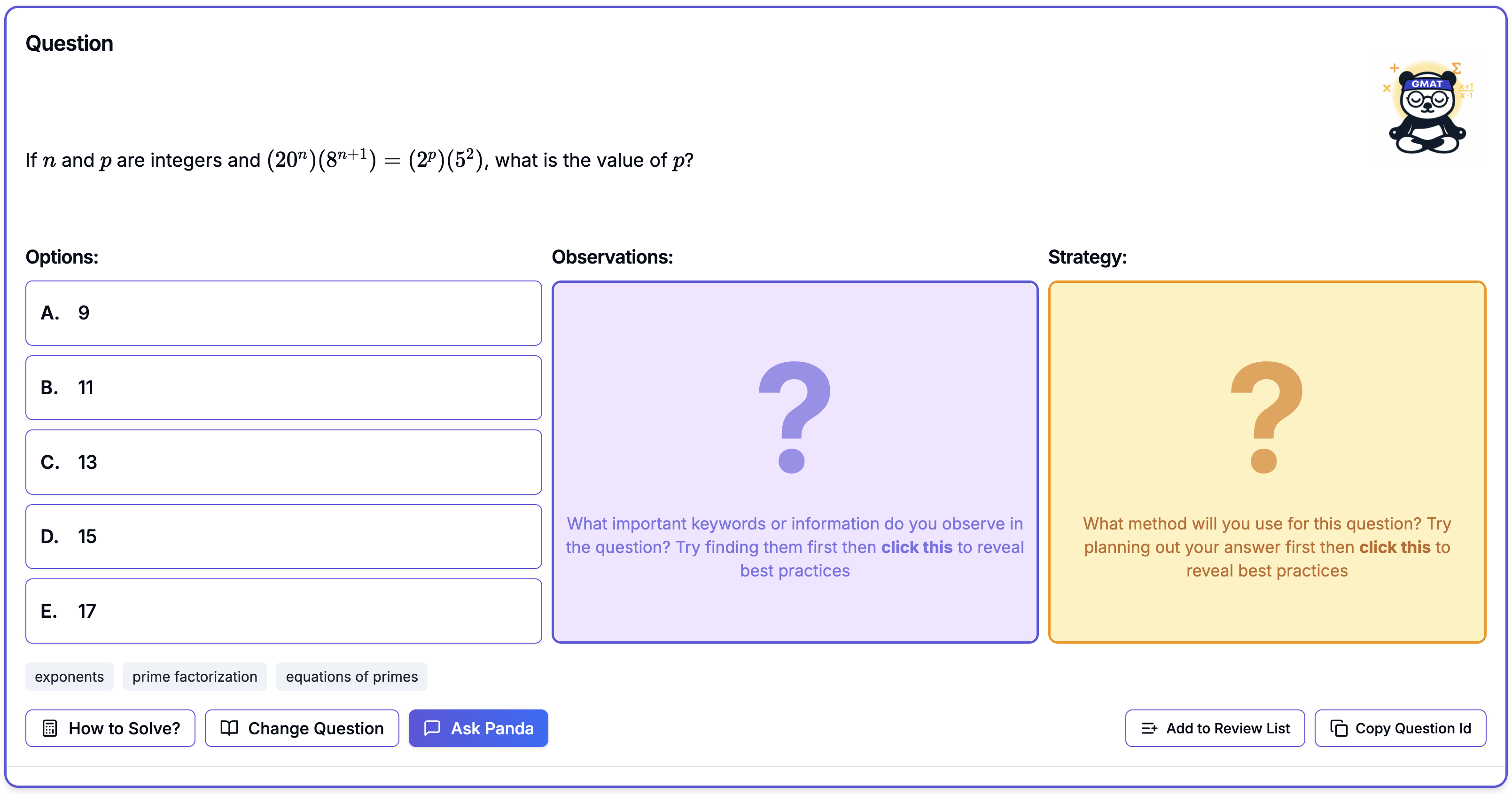
Observations & Strategy cards appear before the solution steps
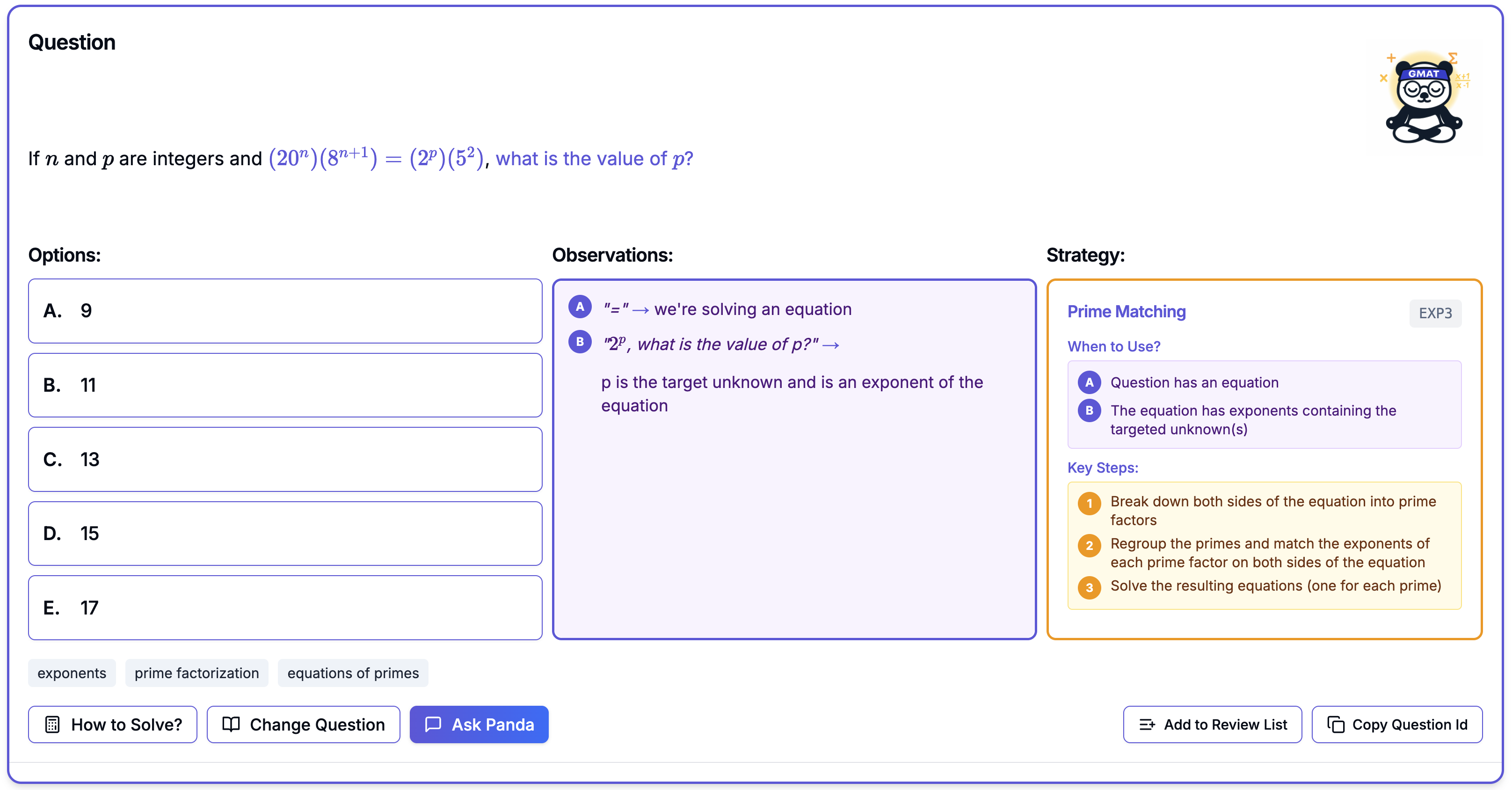
Click Strategy to see which method to use and why
Panic or test anxiety
You froze, second-guessed a correct instinct, or felt the exam get away from you mentally. Stress management on the GMAT is a trainable skill, not a personality trait. There are specific techniques that work and specific prep habits that make exam conditions feel familiar rather than threatening.
Managing GMAT prep stress and test anxiety →Couldn't remember in time
You had an idea of what to do but couldn't recall it fast enough under pressure. This is a retrieval speed problem, not a knowledge problem. Revision cards reviewed with spaced repetition are the most direct fix: they train recall under time pressure rather than just recognition when reading notes.
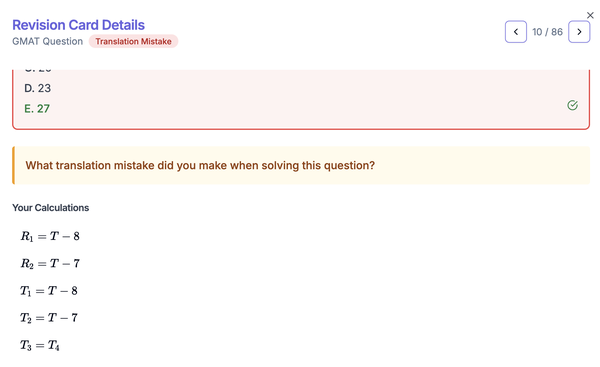
Revision cards in GMAT Panda are added from your practice sessions and reviewed in Revise mode
Let GMAT Panda categorize mistakes for you
In timed drill mode, GMAT Panda can analyze your uploaded workings and automatically flag the type of mistake at the end of each session: translation error, calculation slip, missed assumption, and more. This saves the categorization step and makes the debrief faster.
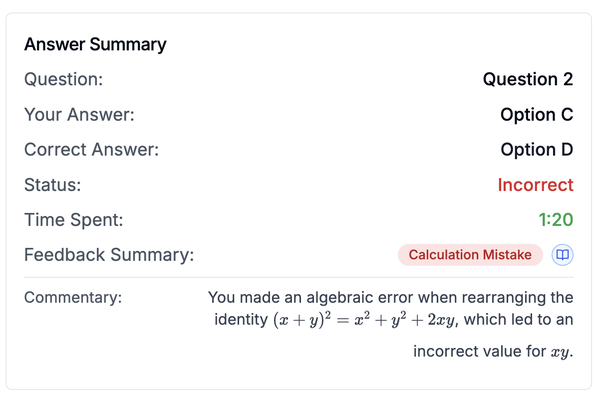
Calculation mistake feedback after a timed drill
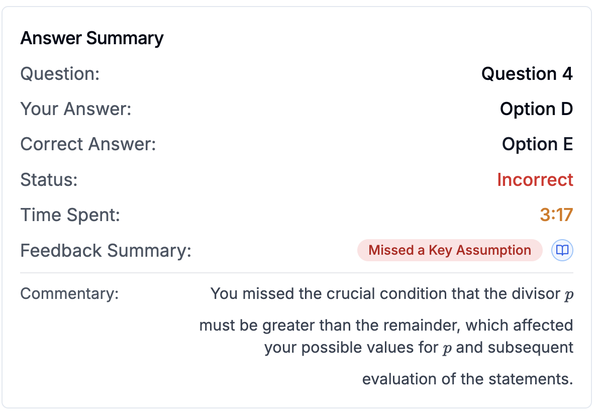
Missed key assumption feedback after a timed drill
Related reading
Continue with these GMAT Panda articles.
Practice with built-in debrief
GMAT Panda walks you through every solution step, shows you which method to use and why, categorizes mistakes automatically in drill mode, and helps you build revision cards on the patterns worth keeping.