GRE MBA scores vs acceptance rate
Compare GRE Verbal and GRE Quant means or medians for leading US MBA programs against estimated acceptance rates (same labels as our GMAT study).
Published
By Graeme O'Connor, Founder of GMAT Panda. 99th percentile GMAT scorer, London Business School MBA alumnus (Dean's List, former Student Ambassador), 10+ years of GMAT tutoring and admissions consulting for top US and European schools.
This page is directional, for comparison and planning. GRE section statistics come from published class profiles and compiled reporting (see Sources). Acceptance rates use the same estimates and confidence labels as our GMAT MBA score ranges page.
For choosing between tests, see our GMAT vs GRE for MBA admissions guide.
Key insights from the data
- Higher reported GRE Verbal and Quant central tendencies cluster at more selective programs, but the relationship is not linear.
- Schools publish means or medians; detailed GRE "middle 80%" splits are uncommon, so use these charts as benchmarks against published class statistics, not full distributions.
- A competitive GRE supports your application; it does not replace essays, work experience, or school fit.
- Acceptance rate labels are directional where schools do not publish official rates.
GRE Verbal vs estimated acceptance rate
MBA program GRE Verbal score vs estimated acceptance rate
Uses mean when available; otherwise median.
GRE Quant vs estimated acceptance rate
MBA program GRE Quant score vs estimated acceptance rate
Uses mean when available; otherwise median.
How to use this as an applicant
How to read the charts
- Each point uses a published mean when available, otherwise a median, for that GRE section.
- Compare your score to the school's published Verbal and Quant statistics, not only one section.
- Use this chart to see how central tendencies line up with estimated admit rates, not to infer a full score range.
Rules of thumb
- Most top MBA programs accept the GRE; admissions committees still care about whether your numbers support your academic readiness.
- Beyond a strong threshold, extra points often have diminishing returns relative to time spent on essays, stories, and fit.
- A higher GRE does not guarantee admission. Other factors still move outcomes at every school on the chart.
Significantly above published Verbal and Quant class averages
Use each school's published means or medians as your anchor. A practical rule of thumb is about 3 or more points above those benchmarks on Verbal and on Quant (each section is scored 130–170). The GRE is unlikely to be your main weakness. Focus on essays, experience, and fit; a retake usually has low ROI unless you have a concrete plan to improve.
Around published class averages
You're in the mix on Verbal and Quant relative to published means or medians, but you are not pulling ahead on scores alone. Your profile (essays, impact, fit) needs to do most of the heavy lifting. A retake can still help at the margin if you have a realistic path to a meaningfully higher score.
About 3 or more points below class averages on Verbal and/or Quant
Same rule of thumb in reverse: about 3 or more points below published means or medians on Verbal or Quant (each 130–170), or clearly weak relative to both. Retaking is often high ROI if you can close the gap. If retaking is not realistic, strengthen the rest of your file and consider schools where your numbers sit closer to class statistics.
If you are preparing for the GMAT, GMAT Panda offers structured, adaptive practice focused on the GMAT Focus.
Start your free trialGood Reasons to Choose One Test or the Other
Choose the GMAT if:
- You're applying to mainly business school programs (MBA, MiM, MiF, etc.)
- You want a stronger academic signal — especially in Quant
- You are seeking scholarship leverage
- You want maximum your chances of getting a consulting or investment banking role
Choose the GRE if:
- You are applying to multiple types of programs (public policy, economics, dual degrees, etc.)
- You love to learn vocabulary
- You dislike the GMAT's Data Insights section
Wrong Reasons to Choose One Exam Over the Other
Many applicants make their test choice based on misconceptions. Here are common mistakes and the reality behind them.
Wrong Reasons to Choose GRE
| Wrong Reason | Reality |
|---|---|
Choosing GRE because you're not good at maths | GMAT Quant questions break into simple steps. Each step is typically high-school level, taught from a different perspective than school math, so struggling with math at school does not mean you cannot score well. Individual calculations stay at times-tables difficulty. The GMAT has more hard questions than the GRE, but that bar is the same for every candidate and schools know it. |
Choosing GRE because your undegraduate was in a non-quantitative or business degree | Studying for the GMAT and getting an ok Quant score will actually reassure business schools a lot more that you can cope with the analytical side of the degree |
Choosing GRE because you think it's easier to get into a top business school with it | Minimum GRE scores of schools are often misleading since outlier profiles tend to take the GRE (they get in thanks to their unique profile rather than because of their GRE score!) |
Choosing GRE because it will be easier to get to your target business role with it | Preparing for the GMAT also prepares you for the kind of skills you need to do well in business school or post-business school roles (which is not so much the case with the GRE) |
Choosing GRE because you're good at writing / think you'll do well in the Analytical Writing section | Business schools don't really care about AW anymore! |
Wrong Reasons to Choose GMAT
| Wrong Reason | Reality |
|---|---|
Choosing GMAT because you have more time per question and you don't like being time pressured | GMAT questions often require more steps, more thinking and more thinking so the time pressure can be high too! |
Choosing GMAT because your memory is not so good and you won't be able to learn all the vocabulary | Actually memory also helps on the GMAT: you still need to recall approaches and number facts quickly, even though each question is rarely identical to one you drilled |
For the full comparison, question-by-section breakdown, and more, see our GMAT vs GRE for MBA admissions guide.
More GMAT guides
- GMAT Focus Exam FAQ (format, scoring basics, and test-day questions)
- GMAT vs GRE for MBA admissions (2026) (which test fits business school)
- Last 48 hours before the GMAT (tips and preparation)
- GMAT Focus section order guide (Quant, Verbal, and Data Insights order)
- Revision cards: good to great (spaced repetition for GMAT prep)
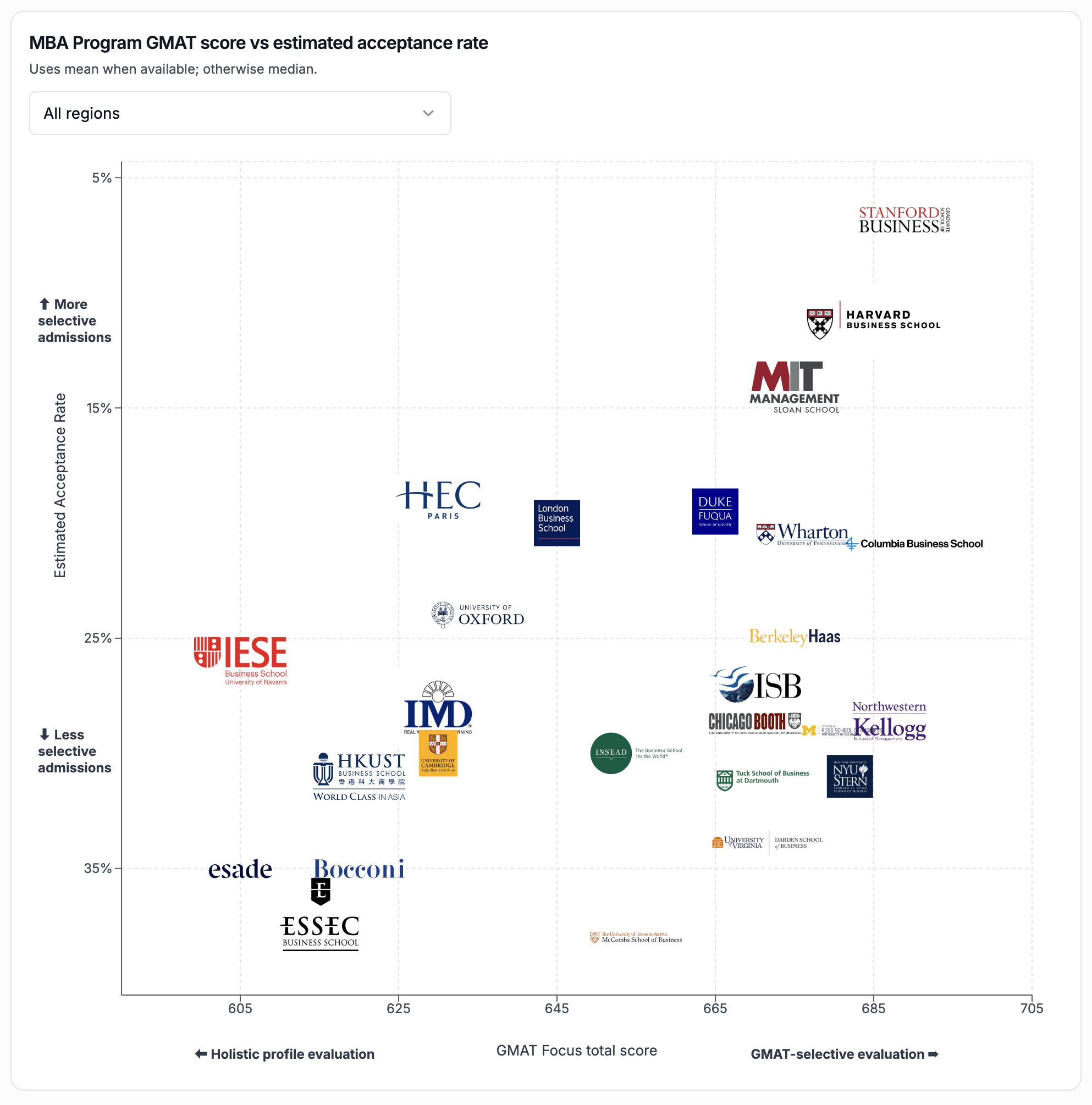
- GMAT MBA score ranges vs acceptance rate (interactive GMAT chart)
Labels such as (Public Data), (Inferred Estimate), and (Rough Estimate) describe how the acceptance rate was sourced. GRE section statistics are compiled primarily from Poets&Quants and other public reporting, with school-level validation where available.
Sources
- Primary dataset (GRE means and much of the cohort coverage): Poets&Quants articles on GRE scores and submission rates at top US MBA programs, for example 2025 GRE submission coverage and 2024 GRE scores at top US programs. School-level Verbal and Quant averages are compiled from disclosures, admissions offices, and class profiles where available.
- Official school pages (validation): class profiles such as Harvard Business School, Stanford GSB, Wharton, and MIT Sloan. Many schools do not publish GRE section means; we used these pages to confirm plausibility and totals, not as the primary extraction path for every split.
- Median and cross-checks: MBA Mission (for example Harvard median GRE discussion), Clear Admit and similar roundups for totals and cross-checking section-level splits where published.
- Percentile mapping (when shown elsewhere): ETS (GRE) for official GRE score-to-percentile relationships.
Methodology
GRE score statistics
We prioritize Poets&Quants compilations and school-reported class profiles where section splits exist. For many programs, only totals or partial splits are public, so we rely on the best available public reporting and treat figures as directional.
Statistic used on the chart
Mean (average) when the school or source reports it for that section; otherwise median. The tooltip states which statistic was used.
Acceptance rates
Same methodology as our GMAT MBA score ranges page: official figures when published; otherwise inferred or rough estimates, labeled in the tooltip.
Percentiles
When a percentile appears in our materials, it is derived using ETS-style mappings for GRE scales, and GMAT Focus mappings for GMAT section scores, for comparison only.
Limitations
- Not all schools publish GRE Verbal and Quant means separately.
- Acceptance rates for some programs are cycle estimates.
- Figures are intended for full-time MBA programs in the covered set.
Last updated:
Related reading
Continue with these GMAT Panda articles.
.png)
Turn insight into prep progress
GMAT Panda helps you build the skills and recognition you need for test day with structured practice and explanations tied to real GMAT-style work.