How Many GMAT Questions Should I Be Doing?
Whether you are working through the Official Guide or building a daily study habit, the question of how many practice questions to do comes up for almost every GMAT candidate. The short answer is: volume matters, but quality and what you do after each question matter more.
The GMAT Is a Pattern Recognition Test
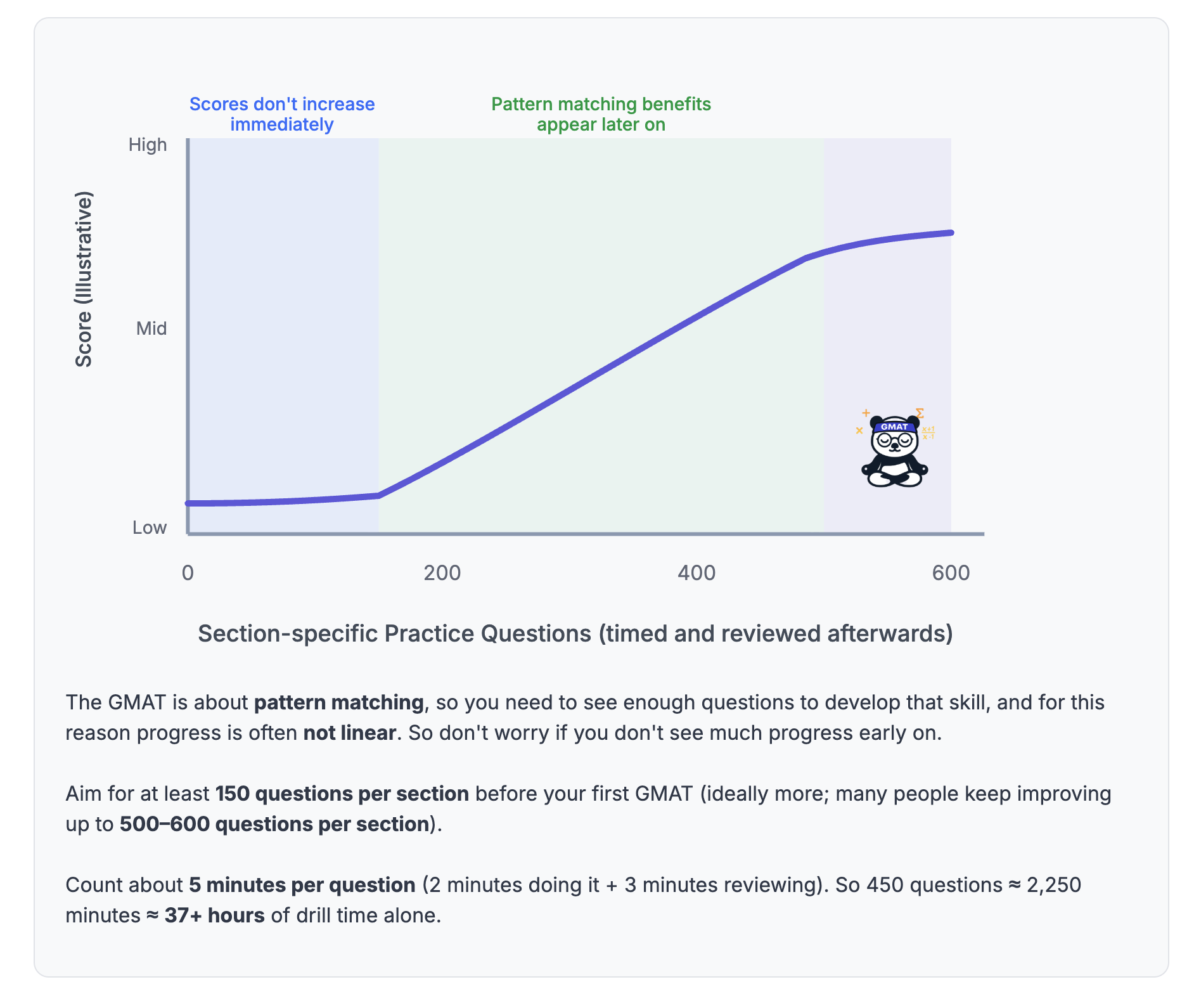
Every question on the GMAT is built from a limited set of underlying structures, traps, and approaches. Score improvement comes from recognizing those patterns, not from raw effort alone. And pattern recognition takes time to develop: it does not click immediately, even when you are doing questions correctly.
Most candidates find that the first 100 to 150 questions in a section feel slow and effortful. Progress can seem minimal. Then, gradually, the same structures start appearing. The same traps show up in different clothes. Approaches that once required working out become automatic. The improvement curve steepens significantly after roughly 150 to 200 questions per section, and continues building as you approach 300 to 400.
How score typically improves with practice questions (per section)
Illustrative. Actual curve depends on quality of practice and debrief.
Quality matters more than quantity
Volume only builds pattern recognition when you are doing the right questions the right way. Use official or similar quality questions or materials carefully designed to reflect what is tested on the most recent forms of the exam. GMAT Panda questions are built to do exactly that.
The time you spend after each question is just as important as the question itself. A question finished and moved past is a missed opportunity. A question reviewed carefully, with the method understood and the mistake categorized, builds the pattern library your brain draws on under exam pressure.
What a Good Question Debrief Looks Like
After each practice batch, the debrief is where the real learning happens. This means reviewing every question in the batch, including the ones you got right, and understanding not just whether you were correct but whether your method was efficient, why the distractors existed, and what the question was actually testing.
A structured debrief also means categorizing any mistakes (wrong method, translation error, calculation slip, time pressure, or retrieval failure) and, when a better approach exists, pinning down the exact trigger condition that should activate it in the future. That trigger is what fires automatically on exam day.
For a complete step-by-step debrief process, see How to Do a Proper GMAT Question Debrief. It covers each step from reviewing correct answers to making revision cards for recurring patterns.
Practical Considerations for Structuring Your Practice
Beyond the total count, how you distribute and approach questions each week has a significant effect on what you retain and how you perform under pressure.
Do questions in timed batches at exam pace
Aim to practice at the same pace as the real exam (roughly 2 minutes per Quant question, 1 minute 40 seconds per Verbal question, and 2 minutes 30 seconds per DI question). Timed conditions train the pacing instincts and decision-making under pressure that the real exam demands. If you are very early in your prep and still learning a technique from scratch, untimed practice is fine for that specific skill. Once you understand it, reintroduce timing.
Avoid doing full mocks too often
Full practice exams are valuable for calibrating your score and building stamina. But they are also exhausting, and doing them too frequently leaves you too depleted to do the focused practice and debrief work that actually builds skills. A good rule: no more than one full mock every 2 to 3 weeks during the bulk of your prep, and never the day before or after a full mock.
Do not do too many questions in one sitting
Cognitive fatigue degrades the quality of both your practice and your debrief. Doing 50 questions in a row when you are exhausted builds less than doing 15 questions when fresh. Shorter, high-quality sessions beat long grinds. As a guideline, most candidates do best with 1 to 2 batches of 10 to 20 questions per study day, with a proper debrief after each.
Still do questions in sections you feel comfortable with
Even if a section feels natural to you, aim for at least a few hundred questions in it. Pattern recognition continues to develop, harder variations become familiar, and efficiency improves. A comfortable section is an opportunity to build a scoring buffer, not a reason to skip practice.
Aim for around 1,000 questions in total across all three sections
Across Quant, Verbal, and Data Insights, 1,000 total questions is a solid target for a full prep cycle. That works out to roughly 300 to 400 questions per section. Over a 2 to 4 month prep timeline, this means doing approximately 60 to 125 questions per week (fewer if you have more time, more if your exam is sooner).
This is a benchmark, not a rigid rule. Candidates with stronger foundations in one section may allocate more questions to a weaker area. What matters is that you reach the volume where patterns become automatic in each section.
Track your questions, mistakes, and progress
Knowing how many questions you have done per section, your accuracy rate over time, and which mistake types repeat gives you the data to adjust your prep. Without tracking, it is easy to over-invest in one area and underdo another without realizing it. A simple log or a platform that tracks this automatically keeps your prep honest.
GMAT Questions: Quick Reference

How Many GMAT Questions?
Targets at a Glance
Patterns click after ~150 questions per section
Early progress feels slow; the curve steepens significantly after this threshold.
Target: ~1,000 questions total
Spread across Quant, Verbal, and Data Insights over 2 to 4 months.
Quant: 350–400 questions
Problem Solving and Data Sufficiency combined.
Verbal: 350–400 questions
Critical Reasoning and Reading Comprehension combined.
Data Insights: 250–300 questions
Across all DI question types: GI, MSR, TA, TPA, and DS.
60–125 questions per week
Should be your equivalent rough target if you have 2-4 months of practice time.
Quality beats quantity every time
Use official questions and always debrief thoroughly after each batch.
Debrief every question, not just wrong ones
Correct answers can still reveal faster methods and missed patterns.
Avoid full mocks more than once every 2–3 weeks
Mocks are for calibration; too many leave you too depleted to learn from practice.
gmatpanda.com/content/how-many-gmat-questions-should-i-do
Related reading
Continue with these GMAT Panda articles.
Practice with built-in tracking and debrief
GMAT Panda tracks your question count per section, flags mistake patterns automatically in drill mode, and helps you build revision cards on the patterns worth keeping. All in one place.