How Business School Applications Build Habits That Last
The application process is long, mentally demanding, and often thankless in the short term. The habits you protect along the way become the foundation you carry into business school and beyond.
A Process That Asks More Than Most People Expect
Applying to business school involves GMAT prep, networking with students and alumni, writing essays, researching schools, and managing multiple deadlines, usually while continuing to work and maintain existing personal commitments. That applies whether you are targeting an MBA or a specialized master's such as finance or management.
Several parts of it also push you outside your comfort zone. Writing honestly about yourself, revisiting math after years away, reaching out to people you've never met, sitting with uncertainty after submitting. The mental cost is easy to underestimate until you're in it.
That difficulty is part of the point. The application process quietly trains the exact habits that business school will demand: managing competing priorities, showing up consistently, and making decisions under uncertainty.
Why Frustration Comes from Expecting Results Too Soon
A lot of the difficulty in the application process comes not from the work itself but from the gap between effort and visible progress.
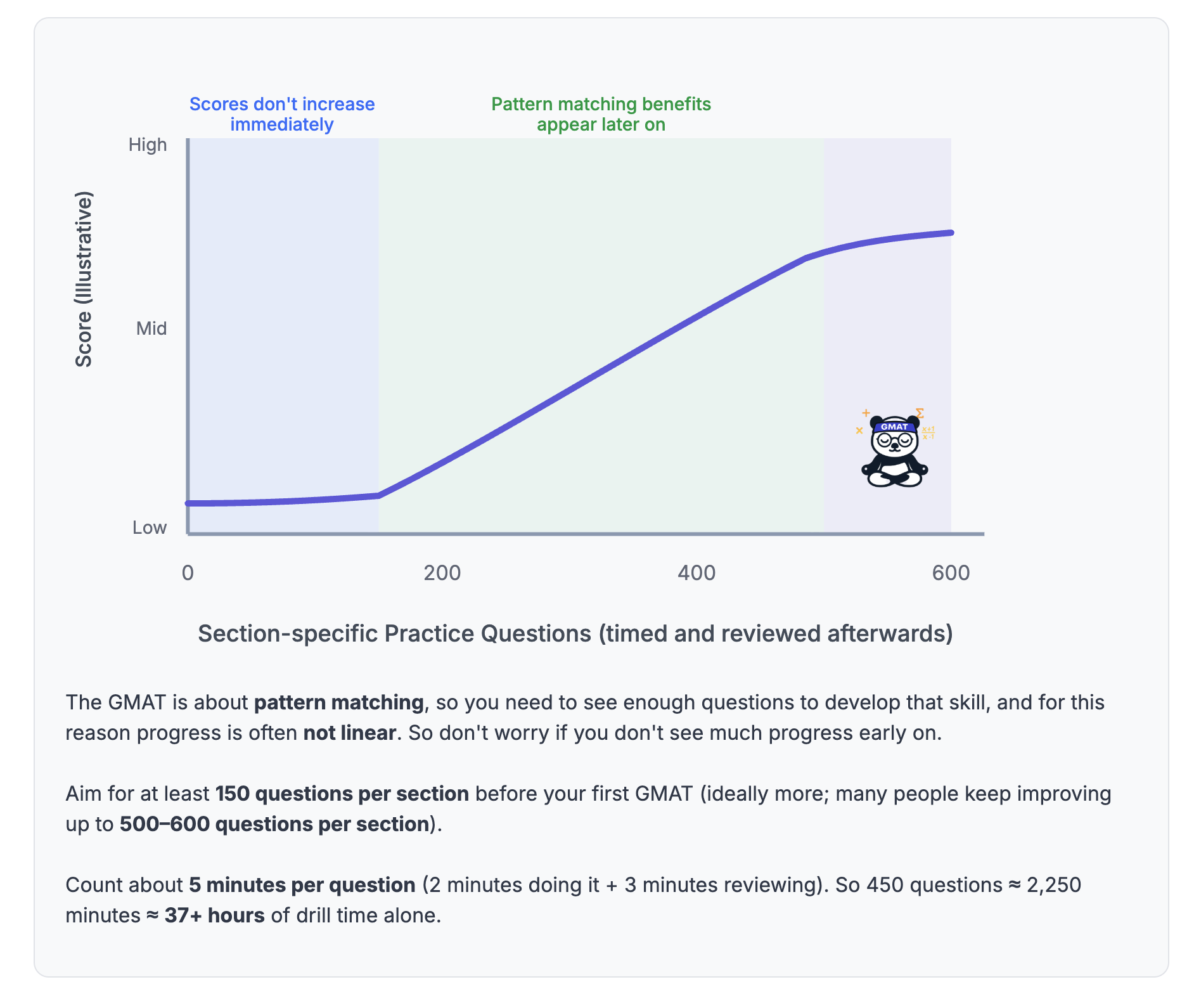
People expect the perfect essay after a few drafts. They expect a GMAT score jump after a few weeks of study. Progress rarely works that way. Skills accumulate slowly at first, then faster than you expect. Humans adapt over months, not days.
At 40% of the way through, reality lags far behind expectation. Stay in long enough and the curve turns.
The chart above shows why timing your assessment matters. Early reps feel unrewarded. The curve is deceptively flat. Many people conclude something is wrong with their approach before the gains have had time to compound. There is a right time to assess progress and adjust. Most people do it too early.
Protect the Inputs, Not the Outcomes
Results are hard to control directly. The GMAT score, the essay quality, the networking outcome. Inputs are entirely within reach. Shifting attention to habits reduces the pressure of constant self-critique and keeps momentum alive when progress feels invisible.
The goal is to protect a small set of daily and weekly habits, and let improvement become a byproduct of consistency. Some examples of inputs to focus on:
20 GMAT questions each morning before work
Morning sessions run on fresh cognitive resources and fit into the schedule before the day's demands arrive. Daily repetition, not volume, is what builds pattern recognition.
One paragraph of an essay each evening after dinner
Small units prevent the blank-page paralysis that comes with treating essays as large blocks. A paragraph a day drafts a full essay in two weeks.
One networking conversation each week
A weekly rhythm makes networking a manageable habit. One conversation per week compounds into 50+ conversations over a year. Spreading them avoids the desperation that comes with last-minute outreach.
One hour blocked every Saturday for applications
A dedicated weekly block for school research, deadlines, and logistics prevents the mental overhead of trying to hold everything in your head across the week.
Growth Often Means Removing, Not Adding
Every hour added to application prep comes from somewhere else. New goals usually require subtracting something from your schedule, not just adding on top of what's already there. The question is whether you make that trade deliberately or let it happen haphazardly.
A useful question at the end of each week: what did I say no to?
Maybe it was a night out, an extra episode, time on a phone, or a commitment that no longer aligned with your priorities. Saying no is uncomfortable in the moment and exactly what business school itself will require. Programs are full of opportunities, events, clubs, and networking obligations. Managing the pressure to say yes to everything is a skill you can start building now, during applications.
Judge the Week by Effort, Not Outcomes
Four questions that give a fairer read on progress than any single result.
Did I protect the study session?
Not did I score well. Not did I get through every question. Did I show up and do the session when it was scheduled?
Did I show up for the reps?
The question is about repetition, not performance. Early reps look flat on the chart. They are still building the foundation.
Did I keep the promises I made to myself?
Consistency with your own commitments builds the kind of self-trust that makes big decisions easier later. The promises matter as much as the work.
What did I intentionally say no to?
Saying no is uncomfortable. It is also the only way to create space for something new. One clear no per week adds up.
Training for Business School and Beyond
In many ways, the application process is practice for business school itself, and for what comes after. Graduate business programs bring more opportunities, events, and responsibilities than anyone can accommodate. The same ambition that drives strong applications also creates risk of overcommitment.
Building systems, habits, and clear boundaries during applications is what makes long-term ambition sustainable. Ambitious people still only get 24 hours in a day. The ones who build well across all of it, school, career, relationships, health, are the ones who got good at saying no before they needed to.
The GMAT is a useful place to start. Our full GMAT preparation guide covers how to build a study plan that fits around a working schedule, including how to pace practice across the months before your exam date.
Start building the GMAT habit
GMAT Panda gives you a personalized study plan and AI coaching that adapts to your pace. Practice daily in short sessions and watch the curve turn.
Related reading
Continue with these GMAT Panda articles.