How Long Should I Study Before Retaking the GMAT?
Getting a lower score than expected is frustrating. The right answer to how long you need to study depends on what went wrong the first time and how thoroughly you fix it.
Step One: Diagnose What Went Wrong
Retaking without understanding the root cause tends to produce the same result. Each type of problem has a different fix and takes a different amount of time to address.
Time management
You felt the clock run out before finishing, had to guess on the last few questions, or spent too long on hard questions early in the section. Time pressure on the GMAT is not just about speed — it is about knowing when to cut a question and move on. Building this instinct takes consistent timed practice across hundreds of questions per section.
Silly mistakes and calculation errors
You understood the method but made arithmetic slips — sign errors, wrong coefficients, misread conditions. These are among the most common GMAT errors and are largely preventable with a structured checking habit. Debrief reveals how often this category appears in your practice mistakes, which is the first step to eliminating it.
Not knowing which method to use
Many questions felt unfamiliar, or you chose the wrong approach from the start. This is the deepest category to fix because it requires building pattern recognition from scratch. You need enough question volume — and thorough debriefs — for the right trigger conditions to become automatic. Of all the root causes, this one takes the most time to address properly.
Anxiety and test nerves
You froze on questions you knew, second-guessed correct answers, or felt the exam spiral out of control mentally. Exam anxiety on the GMAT is a trainable skill. Simulating exam conditions during practice — full timed sessions, no pausing — makes the real thing feel familiar rather than threatening. The fix is in how you practice, not just how much.
Blanking on things you knew
You understood the concepts in practice but could not access them fast enough under exam pressure. This is a retrieval speed problem, not a knowledge problem. Reviewing revision cards with spaced repetition is the most direct fix: cards train active recall under time pressure, while re-reading notes only trains recognition.
Whole topics felt unfamiliar
Some question types were almost completely foreign — you had not covered them properly in your first prep cycle. Add targeted study on those topics before returning to volume practice. Doing more questions in an area you have not studied is not useful and will not build the pattern recognition you need. For foundation gaps, use the topic videos in GMAT Quant Basics.
Going through your answer history section by section and categorizing each wrong answer is the most direct way to identify which of these applies to you. For a step-by-step process, see How to Do a Proper GMAT Question Debrief.
Score Variability and Pattern Recognition
Before setting a study timeline, it helps to understand why GMAT scores vary between attempts even when your preparation level is roughly the same.
Why there is always some score variability
The GMAT is an adaptive test with a limited number of questions per section. The algorithm has to estimate your ability level from that small sample, which introduces statistical noise. A test where you happen to see more of your weak topics will score lower than one where your strong topics come up more often. Neither result is inaccurate — they both reflect the same underlying level with different topic draws.
Sleep quality and stress on exam day also have a measurable effect. A candidate who is well-rested and calm will execute better than the same candidate under fatigue or pressure. A score gap of 30 to 40 points between attempts can reflect variance rather than a real change in your skill level, which means not every drop or jump is meaningful on its own.
This is also why a single practice exam is not a reliable predictor. Your real score range sits within a band, and any given attempt can land anywhere in that band.
Pattern recognition takes a few hundred questions per section
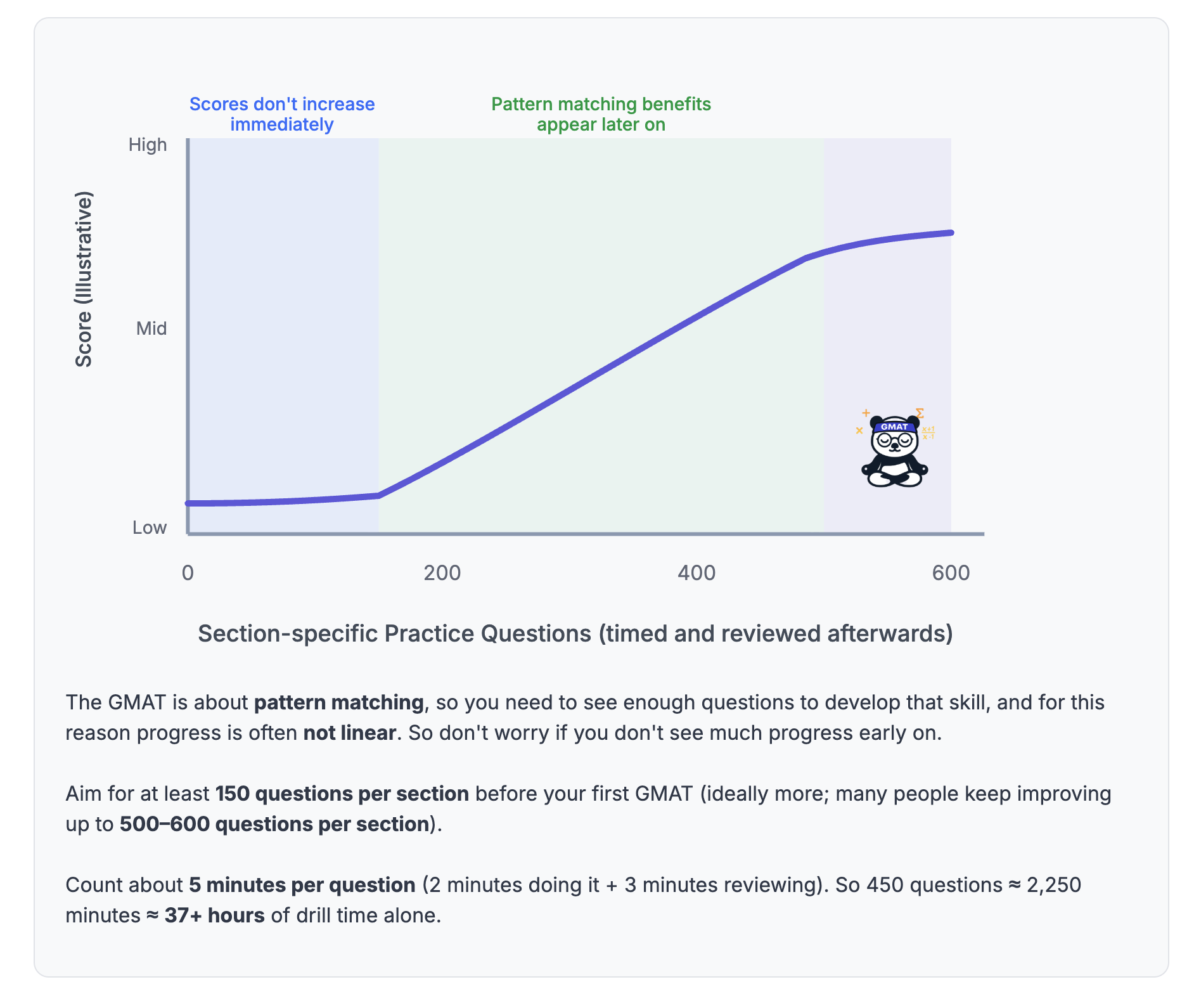
Score improvement on the GMAT comes from recognizing patterns: the same underlying structures, traps, and methods appear across hundreds of different-looking questions. That recognition does not develop quickly. Most candidates find that the first 100 to 150 questions in a section feel slow and effortful, with minimal visible improvement.
The improvement curve steepens after roughly 150 to 200 debriefed questions per section and continues building as you approach 300 to 400. This is the threshold where patterns start firing automatically under exam pressure rather than requiring conscious effort.
Volume alone is not enough. Quality and thorough debrief are what convert practice questions into pattern recognition. Doing 200 questions and skipping the review will not produce the same result as doing 200 questions with careful analysis of every one — including the ones you got right.
The Official Rules on GMAT Retakes
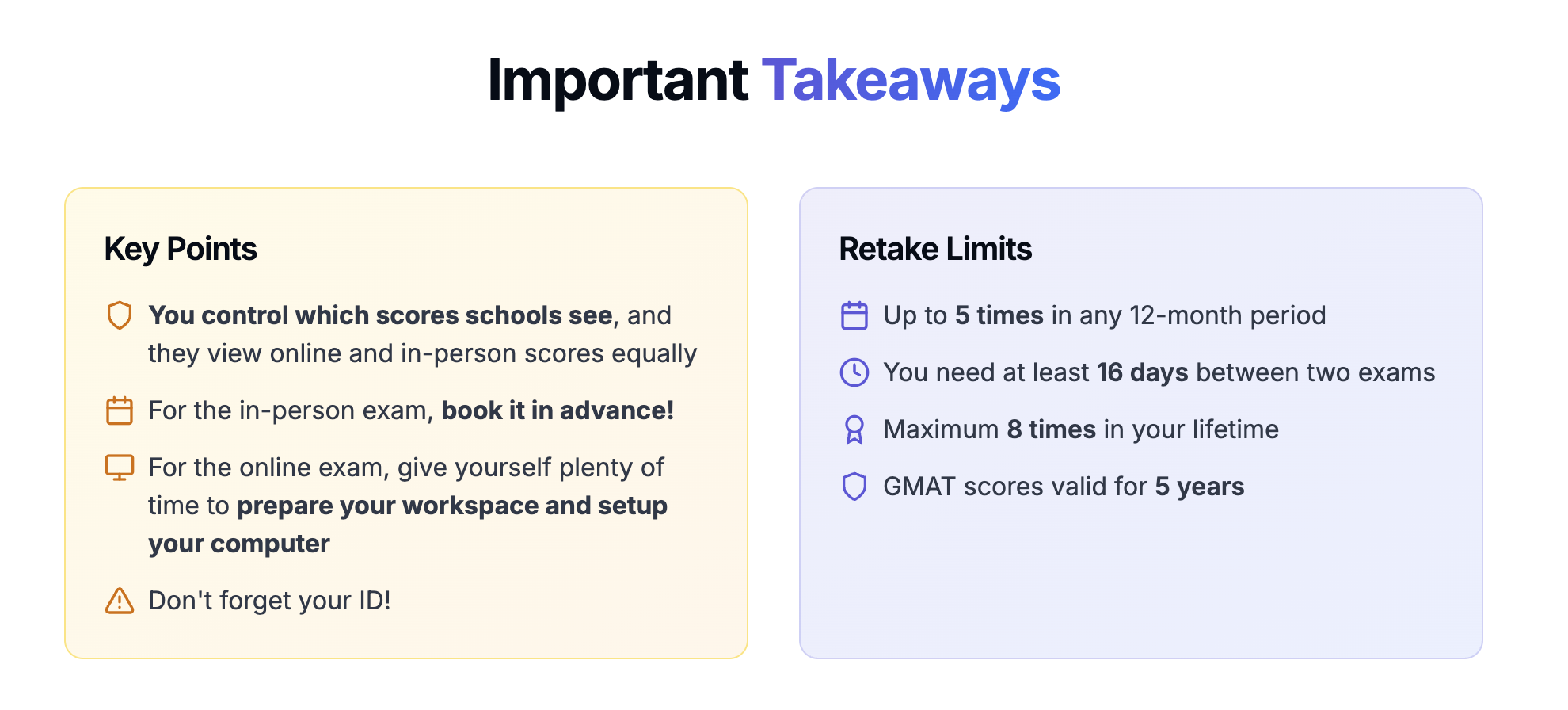
GMAC publishes specific limits on how often you can retake the GMAT Focus Edition. These are the constraints you need to plan around.
 GMAT Panda GMAT Panda | |
|---|---|
| Rule | Detail |
| Minimum time between attempts | 16 days |
| Maximum attempts per 12 months | 5 attempts in a rolling 12-month period |
| Lifetime maximum | 8 attempts across your lifetime |
The 16-day minimum is a floor, not a recommendation. Two weeks is not enough time to build the kind of pattern recognition that moves a score. Retaking in 16 days only makes sense if the first attempt was disrupted by something external — illness, a technical issue, or a one-off circumstance — and your underlying preparation was already solid.
For most candidates, meaningful score improvement requires 1 to 3 months of focused retake prep, with the exact duration depending on how much needs to change. Given the lifetime cap of 8 attempts, it is worth taking enough time between attempts to make each one count.
Don't Let Your Strong Sections Slip
When preparing for a retake, most candidates focus almost entirely on the section where they scored lowest. This is right, but not at the expense of the sections you did well on. GMAT score improvement in one area can be partially offset by regression in another if you stop practicing it for several weeks.
Pattern recognition fades faster than it is built. A section that felt comfortable after your first prep can start feeling rusty within a few weeks without any practice. Aim to do at least 30 questions per section per week — including the sections you did well on — throughout your retake prep.
Revision cards keep strong sections warm
For sections you scored well on, revision cards are especially efficient. Rather than re-doing large volumes of questions, reviewing cards on the patterns and methods you have already trained keeps retrieval speed high with a fraction of the time investment.
A 10-minute card review session three times a week can maintain the fluency that took months to build. Skipping this entirely risks arriving at your retake date with a stronger weak section and a slightly weaker strong one — a net wash.
How revision cards can take you from good to great on the GMAT →The Practical Recommendation
Once you have diagnosed what went wrong, use these targets to estimate the length of your retake prep. These are debriefed questions — not just questions done.
Sections you struggled with: aim for 200+ debriefed questions
For any section where you saw meaningful problems — wrong methods, time management issues, content gaps — 200 properly debriefed questions is a reasonable floor for genuine improvement. Depending on how far you need to move the score, 300 or more may be required. The debrief is not optional: questions done without review contribute far less to pattern recognition.
Sections you did well on: aim for 50–100 debriefed questions
You are maintaining and extending what already works, not rebuilding from scratch. 50 to 100 questions across your stronger sections, combined with regular revision card review, keeps accuracy and pacing dialed in without cannibalizing the time needed for weaker areas.
What this means in practice
If you have two weak sections and one strong one, you are looking at roughly 400 to 600 debriefed questions in total. At a realistic pace of 60 to 80 debriefed questions per week, that is 6 to 10 weeks of focused work. One weak section and two strong ones would be closer to 4 to 6 weeks.
Give yourself a week at the end for one or two full practice exams under proper conditions. The goal of those mocks is pacing and stamina, not learning new patterns. Do not cram additional questions in that final week — arrive at your retake rested and composed.
GMAT Retake Prep: Quick Reference
How Long to Study Before Retaking
Key targets at a glance
Diagnose first, then plan
Identify the root cause of your score before planning your retake prep.
16 days is the minimum, not the target
Two weeks is not enough time to build pattern recognition in any section.
Weak sections: 200+ debriefed questions
The floor for genuine improvement in any section where you struggled.
Strong sections: 50–100 questions minimum
At least 30 per section per week to avoid regression while you focus elsewhere.
Use revision cards to maintain strong sections
Regular card review keeps fluency high with a fraction of the time investment.
Typical retake prep: 6–10 weeks
With one or two full mocks in the final week for stamina and pacing.
Volume without debrief does not move the score
Debrief every question — including correct ones — to build genuine pattern recognition.
gmatpanda.com/content/how-long-study-before-retaking-gmat
Related reading
Continue with these GMAT Panda articles.
Retake prep with built-in debrief
GMAT Panda tracks your questions per section, categorizes mistakes automatically in drill mode, and helps you build revision cards on the patterns worth keeping. Everything you need for a structured retake in one place.